“Place” là một chủ đề quen thuộc trong IELTS Speaking nhưng không ít bạn vẫn lúng túng khi nói về những địa điểm gắn với ký ức cá nhân. Nếu bạn cũng đang băn khoăn không biết triển khai ý ra sao với đề describe a school you went to in your childhood, thì đừng lo nhé. Trong bài viết này, The Catalyst for English sẽ đồng hành cùng bạn, hướng dẫn cách trả lời mạch lạc và tự nhiên để bạn tự tin ghi điểm trong phòng thi IELTS.
I. Phân tích đề bài describe a school you went to in your childhood
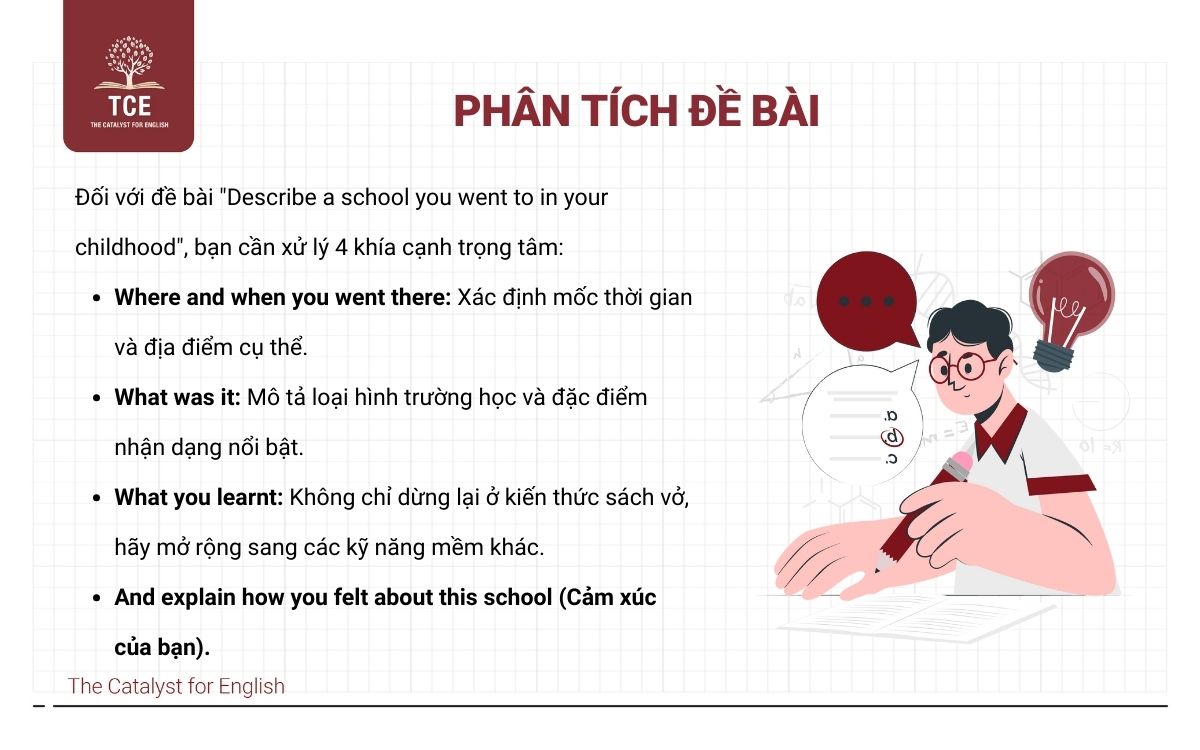
Việc phân tích kỹ các yêu cầu trong Cue card là bước then chốt để đảm bảo tính Task Response (hoàn thành yêu cầu bài thi). Đối với đề bài “Describe a school you went to in your childhood”, bạn cần xử lý 4 khía cạnh trọng tâm:
Where and when you went there (Ở đâu và khi nào): Xác định mốc thời gian (thường là cấp 1 hoặc cấp 2) và địa điểm cụ thể (nông thôn hay thành thị). Sử dụng các cụm từ chỉ thời gian như: “Back in the early 2010s”, “During my formative years”.
What was it (Đó là ngôi trường như thế nào): Mô tả loại hình trường học (trường công, trường tư, hay trường chuyên) và đặc điểm nhận dạng nổi bật (màu sơn, hàng cây, hay sân chơi).
What you learnt (Bạn đã học được gì): Không chỉ dừng lại ở kiến thức sách vở, bạn hãy mở rộng sang các kỹ năng mềm như làm việc nhóm, kỷ luật hoặc các bài học đạo đức đầu đời.
And explain how you felt about this school (Cảm xúc của bạn): Đây là phần quan trọng nhất để thể hiện sự gắn kết cảm xúc. Và thí sinh nên sử dụng các tính từ mạnh như “nostalgic” (hoài niệm), “reminiscent” (nhớ lại), hoặc “deeply attached to” (gắn bó sâu sắc).
II. Từ vựng chủ đề describe a school you went to in your childhood
Để có thể xử lý thật trôi chảy describe a school you went to in your childhood, chúng mình hãy cùng TCE củng cố vốn từ vựng về chủ đề này trước khi nói nhé:
Từ vựng
Ý nghĩa
State-of-the-art facilities
Cơ sở vật chất hiện đại, tối tân.
A purpose-built campus
Một khuôn viên được xây dựng với mục đích giáo dục chuyên biệt.
A stone’s throw from my house
Rất gần nhà (thay cho “near”).
Lush green playground
Sân chơi xanh mướt, nhiều cây cối.
Fostered a sense of community
Nuôi dưỡng tinh thần cộng đồng.
Competitive yet supportive environment
Môi trường cạnh tranh nhưng vẫn hỗ trợ lẫn nhau.
Well-rounded education
Giáo dục toàn diện (cả văn hóa và kỹ năng).
Academic performance
Kết quả học tập.
To take a trip down memory lane
Ôn lại những kỷ niệm cũ.
The apple of my eye
Người mà tôi rất yêu quý (có thể nói về một giáo viên).
To be as bright as a button
Thông minh, nhanh nhẹn (mô tả bản thân hoặc bạn bè lúc nhỏ).
To learn something by heart
Học thuộc lòng cái gì đó.
Reminisce about
Hồi tưởng về (thay cho “remember”).
Go back to
Quay trở lại (thời gian).
Scribble down
Ghi chép nhanh, nguệch ngoạc.
Knuckle down
Bắt đầu học tập chăm chỉ.
III. Bài mẫu describe a school you went to in your childhood part 2
To be honest, I’ve attended several educational institutions, but the one that holds a special place in my heart is my quaint primary school, located in a quiet neighborhood of my hometown. I spent five formative years there, from the age of six until I was eleven, and it truly laid the foundation for who I am today.
The school wasn’t particularly large or state-of-the-art; in fact, it was quite modest with just a few blocks of classrooms and a small courtyard. However, what it lacked in modern facilities, it more than made up for with its nurturing atmosphere.
In terms of what I studied, it was there that I was first introduced to the fundamentals of Literacy, Numeracy, and Science. But beyond the academic curriculum, the school was a place where I acquired essential soft skills. I learned the importance of discipline, teamwork, and how to build meaningful relationships. I vividly remember my teachers, who were not just educators but mentors; they had a knack for making even the most tedious subjects engaging through interactive activities.
Reflecting on those years, I feel a deep sense of nostalgia. I remember the school as a safe haven – a ‘home away from home’ where I felt encouraged to explore my potential without the fear of failure. It was an environment that fostered curiosity and instilled in me a lifelong love for learning.
Even now, whenever I pass by those old gates, I’m flooded with memories of laughter on the playground and the sense of belonging I felt. It was undoubtedly a pivotal chapter of my childhood that I will always cherish.
Từ vựng ghi điểm:
Từ
Phiên âm
Ý nghĩa
Hold a special place in my heart
/hoʊld ə ˈspɛʃəl pleɪs ɪn maɪ hɑːrt/
Có một vị trí đặc biệt trong trái tim (rất quan trọng)
Quaint
/kweɪnt/
Đẹp theo kiểu cổ kính, độc đáo, lạ mắt
Modest
/ˈmɒd.ɪst/
Khiêm tốn, giản dị (không phô trương)
Nurturing atmosphere
/ˈnɜːrtʃərɪŋ ˈæt məs fɪər/
Bầu không khí nuôi dưỡng, hỗ trợ phát triển
Safe haven
/seɪf ˈheɪ.vən/
Nơi trú ẩn an toàn, nơi tạo cảm giác yên tâm
Home away from home
/hoʊm əˈweɪ frʌm hoʊm/
Ngôi nhà thứ hai (nơi thoải mái như ở nhà)
Formative years
/ˈfɔːrmətɪv jɪərz/
Những năm tháng hình thành nhân cách
Lay the foundation
/leɪ ðə faʊnˈdeɪʃn/
Đặt nền móng/nền tảng
State-of-the-art
/ˌsteɪt əv ði ˈɑːrt/
Hiện đại, tiên tiến nhất
Literacy and Numeracy
/ˈlɪtərəsi ənd ˈnjuːmərəsi/
Kỹ năng đọc viết và kỹ năng tính toán
Soft skills
/sɒft skɪlz/
Kỹ năng mềm
Mentor
/ˈmentɔːr/
Người cố vấn, người hướng dẫn tận tâm
Have a knack for
/hæv ə næk fɔːr/
Có năng khiếu/có mẹo làm việc gì đó rất giỏi
Tedious
/ˈtiːdiəs/
Tẻ nhạt, chán ngắt
Deep sense of nostalgia
/diːp sɛns əv nɒˈstældʒə/
Cảm giác hoài niệm sâu sắc
Foster curiosity
/ˈfɒstər ˌkjʊəriˈɒsəti/
Thúc đẩy, nuôi dưỡng sự tò mò
Instill
/ɪnˈstɪl/
Thấm nhuần, vun đắp
Pivotal chapter
/ˈpɪvətl ˈtʃæptər/
Chương/giai đoạn then chốt, quan trọng
Cherish
/ˈtʃerɪʃ/
Trân trọng, yêu thương
IV. Bài mẫu describe a school you went to in your childhood part 3
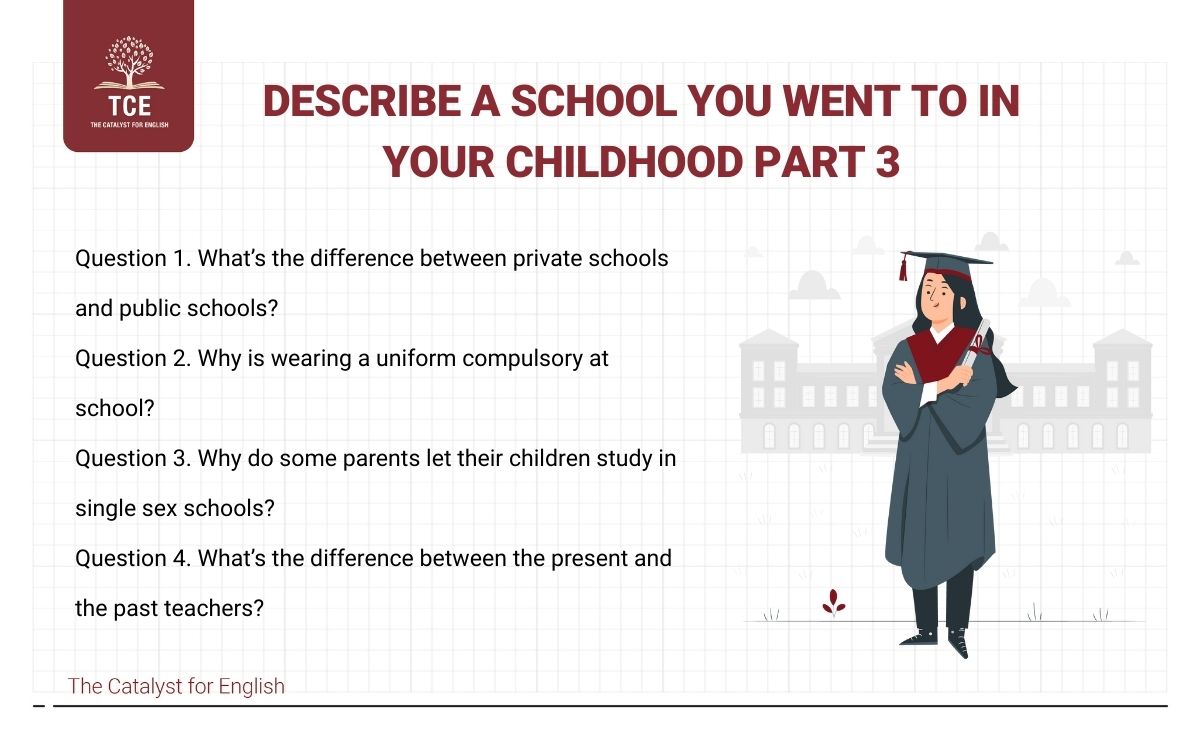
Question 1. What’s the difference between private schools and public schools?
The main difference lies in the funding, which determines the quality of facilities available. Public schools are more affordable and open to students from all walks of life, though they often face overcrowded classes. Meanwhile, private schools use tuition fees to provide top-notch equipment and have more leeway to teach international programs instead of strictly following the national curriculum.
Question 2. Why is wearing a uniform compulsory at school?
Compulsory uniforms help level the playing field, ensuring students from different backgrounds feel equal. It removes the pressure to wear trendy clothes, which prevents bullying and helps everyone feel like they belong. Moreover, uniforms simplify getting ready and stop kids from fussing over what to wear, allowing them to stay focused on their lessons and build better discipline.
Question 3. Why do some parents let their children study in single sex schools?
Some parents opt for single-sex education primarily to eliminate gender-related distractions, believing that students can focus more intently on their academics without the social pressure of impressing the opposite sex. This environment often allows for a tailored teaching approach that caters to the specific learning styles or developmental needs of boys or girls, which can boost their confidence in subjects traditionally dominated by one gender. Additionally, such schools are thought to break down gender stereotypes, encouraging students to explore a wider range of extracurricular activities and leadership roles. Ultimately, it is often seen as a way to create a nurturing and focused atmosphere that maximizes a child’s academic and personal potential.
Question 4. What’s the difference between the present and the past teachers?
The most striking difference is the transition from a teacher-centered approach to a more student-oriented one. In the past, educators were often seen as the sole authority figures and primary sources of information, relying heavily on rote memorization and strict discipline. Conversely, modern teachers act more as facilitators or mentors, leveraging digital tools and interactive methods to encourage critical thinking and collaboration. Furthermore, while past teaching was largely confined to textbooks, today’s educators must be tech-savvy to integrate multimedia resources and address the diverse learning needs of a globalized, digital-native generation.
Để chuẩn bị hiệu quả cho kỳ thi IELTS, việc luyện tập đều đặn, đặc biệt với Speaking và Writing, là yếu tố then chốt. Tại TCE, các khóa học IELTS được thiết kế bài bản với giảng viên giàu kinh nghiệm, lớp học sĩ số nhỏ và các buổi bổ trợ 1 1 hằng tuần, giúp bạn được hỗ trợ sát sao và đúng trọng tâm.
Ngoài ra, TCE còn tổ chức các buổi thi thử IELTS đủ 4 kỹ năng, giúp bạn đánh giá chính xác năng lực hiện tại. Bài thi được chấm và nhận xét chi tiết bởi đội ngũ giám khảo chuyên môn, từ đó bạn dễ dàng nhận ra điểm mạnh và những phần cần cải thiện trước kỳ thi chính thức.
Như vậy, chúng mình đã cùng nhau hoàn thiện câu trả lời cho Part 2 và tham khảo thêm một số câu hỏi Part 3 của đề describe a school you went to in your childhood. TCE hi vọng rằng với cách triển khai ý tưởng và từ vựng gợi ý trong bài, bạn sẽ tự tin ghi điểm trước ban giám khảo nếu gặp chủ đề này trong phòng thi. Đừng quên luyện tập thường xuyên để phản xạ nói ngày càng tự nhiên hơn nhé!
Xin chào, mình là Phương ThảoCo-founder tại The Catalyst for English. Với hơn 7 năm kinh nghiệm đồng hành cùng các bạn học viên trên con đường chinh phục tiếng Anh, IELTS và sở hữu điểm Overall 8.5, mình luôn mong muốn chia sẻ những phương pháp học tập hiệu quả nhất để giúp bạn tiết kiệm thời gian và đạt được kết quả cao.
Tại The Catalyst for English, mình cùng đội ngũ giáo viên luôn đặt 3 giá trị cốt lõi: Connected – Disciplined – Goal-oriented (Kết nối – Kỉ luật – Hướng về kết quả) lên hàng đầu. Bởi chúng mình hiểu rằng, mỗi học viên đều có những điểm mạnh và khó khăn riêng, và vai trò của "người thầy" là tạo ra một môi trường học tập thân thiện, luôn luôn thấu hiểu và đồng hành từng học viên, giúp các bạn không cảm thấy "đơn độc" trong một tập thể.
Những bài viết này được chắt lọc từ kinh nghiệm giảng dạy thực tế và quá trình tự học IELTS của mình, hy vọng đây sẽ là nguồn cảm hứng và hành trang hữu ích cho các bạn trên con đường chinh phục tiếng Anh.
 thecatalyst.edu.vn