Describe a law on environmental protection your country should have là một chủ đề xuất hiện khá thường xuyên trong IELTS Speaking Part 2, yêu cầu thí sinh vừa có ý tưởng xã hội rõ ràng vừa biết cách trình bày quan điểm bằng tiếng Anh mạch lạc. Để giúp bạn tự tin trả lời và ghi điểm với giám khảo, The Catalyst for English đã chuẩn bị bài mẫu tham khảo chi tiết, kèm theo hệ thống từ vựng và cấu trúc ngữ pháp ăn điểm ngay trong bài viết dưới đây.
I. Phân tích đề bài Describe a law on environmental protection your country should have
Trong IELTS Speaking Part 2, chủ đề về “Law” (Luật pháp) luôn được đánh giá là một trong những chủ đề khó vì đòi hỏi vốn từ vựng chuyên ngành và tư duy logic. Để giải quyết tốt đề bài “Describe a law on environmental protection your country should have”, bạn cần bám sát cấu trúc đề bài nhưng phải lồng ghép được các yếu tố thực tiễn tại Việt Nam.
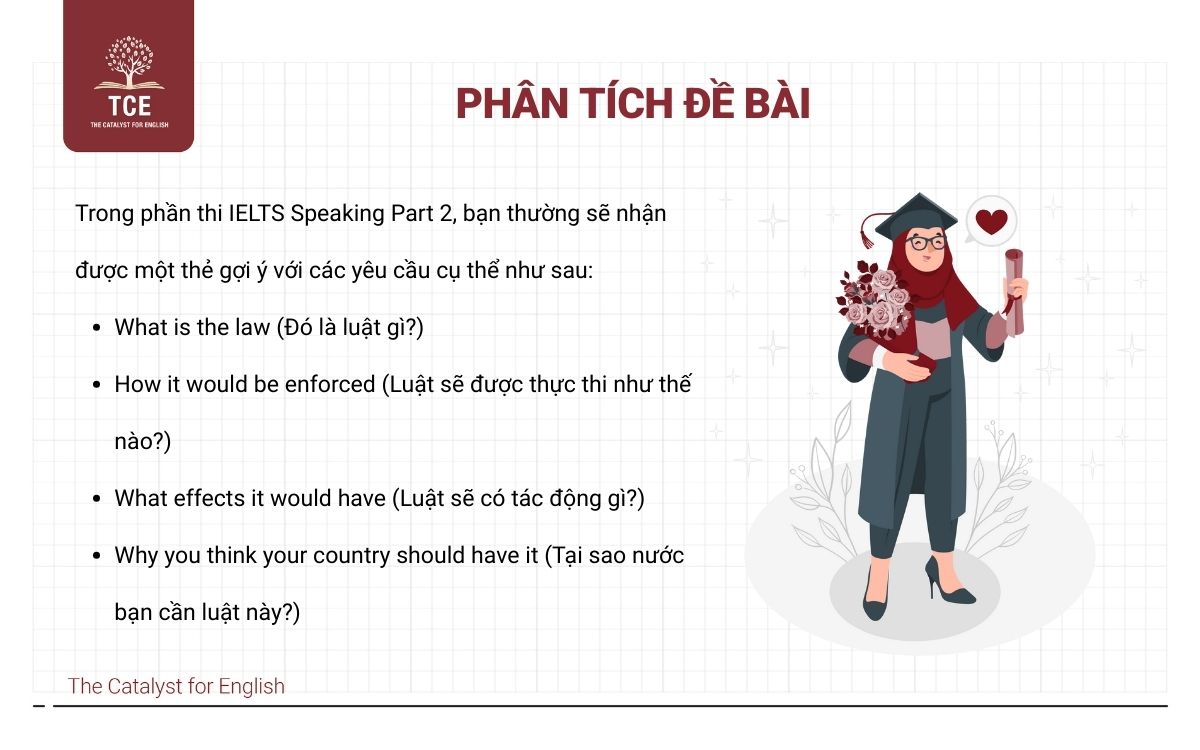
Một bài nói đạt điểm cao cần trả lời đầy đủ và mở rộng các gợi ý (prompts) thường gặp trong bộ đề dự báo:
- What is the law (Đó là luật gì?): Bạn nên chọn một đạo luật cụ thể, dễ nói và có tính cấp thiết. Ví dụ: Luật cấm túi nilon (A ban on plastic bags), Luật bắt buộc phân loại rác (Mandatory waste sorting), hoặc Luật đánh thuế khí thải (Carbon tax for vehicles).
- How it would be enforced (Luật sẽ được thực thi như thế nào?): Đây là phần quan trọng để thể hiện từ vựng về quản lý nhà nước. Gợi ý: Sử dụng camera giám sát (CCTV surveillance), mức phạt nặng (stringent fines), hoặc lực lượng cảnh sát môi trường (environmental police).
- What effects it would have (Luật sẽ có tác động gì?): Tập trung vào thay đổi hành vi và môi trường. Gợi ý: Giảm thiểu rác thải nhựa (mitigate plastic waste), cải thiện chất lượng không khí (improve air quality), nâng cao ý thức cộng đồng (raise public awareness).
- Why you think your country should have it (Tại sao nước bạn cần luật này?): Kết nối với tình trạng thực tế. Gợi ý: Do tình trạng ô nhiễm trắng (white pollution) đang ở mức báo động hoặc các bãi rác quá tải (overloaded landfills) tại các đô thị lớn như Hà Nội hay TP.HCM.
II. Một số từ vựng cho chủ đề “Law” (Luật)
Để giúp bạn mở rộng vốn từ vựng cho chủ đề “Law” trong IELTS Speaking, cô Thảo 8.5 IELTS, giáo viên tại The Catalyst for English, đã tổng hợp một số từ vựng và cấu trúc thường gặp, dễ áp dụng và giúp câu trả lời của bạn trở nên tự nhiên, thuyết phục hơn:
| Từ |
Ý nghĩa |
Ví dụ |
| Pass a new law (referring to something) |
Thông qua một bộ luật mới |
The government has just passed a new law on plastic waste management. (Chính phủ vừa thông qua một đạo luật mới về quản lý rác thải nhựa.) |
| Adhere to / comply with / abide by something |
Tuân thủ |
All staff must adhere to the safety regulations. (Tất cả nhân viên phải tuân thủ các quy định an toàn.) |
| New regulations are introduced to / brought in to … |
Các quy định mới được đưa ra/giới thiệu nhằm… |
New regulations are introduced to limit the use of single-use plastics in supermarkets. (Các quy định mới được đưa ra nhằm hạn chế việc sử dụng nhựa dùng một lần tại các siêu thị.) |
| Standardize something |
Tiêu chuẩn hóa một thứ gì đó |
We need to standardize the components to reduce manufacturing costs.” (Chúng ta cần tiêu chuẩn hóa các linh kiện để giảm chi phí sản xuất.) |
| Have an obligation to V |
Có nghĩa vụ phải làm gì / Có bổn phận phải làm gì |
Every citizen has an obligation to obey the law.” (Mọi công dân đều có nghĩa vụ phải tuân thủ pháp luật.) |
| In breach of (the law) |
Vi phạm (luật/hợp đồng/quy định) |
Any factory that pours chemicals into the river is in breach of environmental regulations.” (Bất kỳ nhà máy nào đổ hóa chất xuống sông đều đang vi phạm các quy định về môi trường.) |
| Satisfy the requirements |
Đáp ứng các yêu cầu / Thỏa mãn các điều kiện |
She didn’t satisfy the requirements for the position, so she wasn’t hired.” (Cô ấy không đáp ứng đủ yêu cầu cho vị trí đó, vì vậy cô ấy đã không được nhận.) |
| Tighten controls |
Siết chặt kiểm soát |
Security has been tightened at the airport following the incident.” (An ninh đã được siết chặt tại sân bay sau sự cố đó.) |
| Infringe the regulations = break the rules |
Vi phạm quy định |
If you infringe the school regulations, you may face suspension.” (Nếu bạn vi phạm nội quy nhà trường, bạn có thể đối mặt với việc bị đình chỉ học.) |
| Flout the rules |
Xem thường luật lệ / Công khai vi phạm |
Motorcyclists who flout the traffic rules by running red lights are a danger to everyone.” (Những người đi xe máy công khai vi phạm luật giao thông bằng cách vượt đèn đỏ là mối nguy hiểm cho mọi người.) |
| be granted permission to V |
Được ban cho phép/được chấp thuận làm gì |
You must be granted permission to access these confidential files.” (Bạn phải được cấp phép để truy cập vào các tập tin bảo mật này.) |
| Seek permission to V |
Xin phép làm điều gì đó / Tìm kiếm sự cho phép |
Companies must seek permission from the local authorities before discharging treated water into the river.” (Các công ty phải xin phép chính quyền địa phương trước khi xả nước đã qua xử lý xuống sông.) |
| Cut through the red tape |
Cắt giảm thủ tục rườm rà |
New policies were introduced to cut through the red tape and encourage people to start their own businesses.” (Các chính sách mới đã được ban hành để giảm bớt rào cản hành chính và khuyến khích người dân khởi nghiệp.) |
III. Một số từ vựng cho chủ đề “Environment” (Môi trường)
| Từ |
Ý nghĩa |
Ví dụ |
| Disposal of household waste |
Việc xử lý/vứt bỏ rác thải gia đình |
Improper disposal of household waste can lead to severe soil and water pollution.” (Việc xử lý rác thải sinh hoạt không đúng cách có thể dẫn đến ô nhiễm đất và nước nghiêm trọng.) |
| Dump waste |
Đổ rác hoặc chất thải |
Strict fines should be imposed on those who dump waste on the roadside.” (Cần áp dụng các hình phạt nghiêm khắc đối với những người đổ rác bên lề đường.) |
| Harmful to the environment |
Có hại cho môi trường |
Plastic bags are extremely harmful to the environment because they take hundreds of years to decompose.” (Túi nilon cực kỳ có hại cho môi trường vì chúng mất hàng trăm năm để phân hủy.) |
| Toxic waste |
Chất thải độc hại |
“The factory was fined for dumping toxic waste into the local river.” (Nhà máy đã bị phạt vì đổ chất thải độc hại xuống dòng sông địa phương.) |
| Public health |
Sức khỏe công cộng |
“The government passed the law to ensure better public health standards in urban areas.” (Chính phủ đã thông qua luật để đảm bảo các tiêu chuẩn sức khỏe cộng đồng tốt hơn ở các khu vực đô thị.) |
| Environmental catastrophe |
Thảm họa môi trường |
“The oil spill in the ocean was an environmental catastrophe that killed thousands of marine animals.” (Vụ tràn dầu trên đại dương là một thảm họa môi trường đã giết chết hàng ngàn động vật biển.) |
| Reduce carbon footprint |
Giảm lượng khí thải carbon |
“We can reduce our carbon footprint by cycling to work instead of driving.” (Chúng ta có thể giảm lượng khí thải carbon bằng cách đạp xe đi làm thay vì lái xe.) |
| Dire consequences for someone / something |
Hậu quả thảm khốc |
The failure to cut through the red tape could have dire consequences for small businesses.” (Việc không thể cắt giảm thủ tục rườm rà có thể gây ra những hậu quả nghiêm trọng cho các doanh nghiệp nhỏ.) |
| Run dry |
Cạn kiệt |
“If the government doesn’t tighten controls on spending, the public funds will soon run dry.” (Nếu chính phủ không siết chặt kiểm soát chi tiêu, công quỹ sẽ sớm cạn kiệt.) |
IV. Answer sample describe a law on environmental protection your country should have
I’m going to talk about the anti-littering law which is a great law to protect the environment that I think the Vietnamese government should impose. One typical country that has been applying this law and has achieved wonderful success is Singapore. I haven’t been there before but I have some friends who have and they all told me that Singapore was a beautiful country. The streets there were impeccably clean and you wouldn’t see any waste or litter on them. I did some digging on the internet about how they did that and I found out their key method was to enact a strict law on littering. Under this law, if anybody gets caught throwing something on the street, be it international tourists or government officials, they will have to pay a heavy fine. In the worst-case scenario, they may be put in jail for a certain period of time. In other words, if you litter when you set foot in Singapore, you are in big trouble. This law has proven really effective ever since it was passed so I think our government should try to follow it. At the moment, lots of Vietnamese people still have a bad habit of leaving trash in public places or when they’re commuting, which is quite terrible. If our government could do the same things as Singapore does, I believe Vietnam would become a much better place to live and visit. Also, our environment would reap huge benefits in the long run. People have been disposing of garbage of all kinds into water sources in their locality such as rivers, lakes, or seas. This has severely contaminated the water and threatened marine life. If this law were introduced, we could bring back clean water in many parts of our country, which in turn, would significantly reduce the number of animals suffering from improperly discarded trash.
Từ vựng ghi điểm:
| Từ |
Phiên âm |
Ý nghĩa |
| Anti-littering law |
/ˌæntiˈlɪtərɪŋ lɔː/ |
Luật chống xả rác |
| Impose (a law) |
/ɪmˈpəʊz/ |
Ban hành/áp đặt |
| Impeccably clean |
/ɪmˈpekəbli kliːn/ |
Sạch sẽ không tì vết |
| Do some digging |
/duː sʌm ˈdɪɡɪŋ/ |
Tìm hiểu kỹ/nghiên cứu sâu |
| Enact |
/ɪnˈækt/ |
Ban hành (luật) |
| Heavy fine |
/ˈhevi faɪn/ |
Khoản tiền phạt nặng |
| Set foot in |
/set fʊt ɪn/ |
Đặt chân đến |
| Reap huge benefits |
/riːp hjuːdʒ ˈbenɪfɪts/ |
Thu được lợi ích to lớn |
| In the long run |
/ɪn ðə lɒŋ rʌn/ |
Về lâu về dài |
| Dispose of |
/dɪˈspəʊz əv/ |
Vứt bỏ/xử lý (rác thải) |
| Contaminate |
/kənˈtæmɪneɪt/ |
Làm ô nhiễm/làm bẩn |
| Marine life |
/məˈriːn laɪf/ |
Đời sống sinh vật biển |
V. Answer sample describe a law on environmental protection your country should have part 3
Question 1. Is there any situation wherein people may disobey the law?
In some extreme cases, people might flout the rules when they feel a law is unjust or fails to protect public health, leading them to believe they have a moral obligation to act otherwise. For instance, if a company is found dumping toxic waste that is clearly harmful to the environment although they already have the permission, local citizens might protest or block access to prevent an environmental catastrophe.
Question 2. Do people like being a police officer in your country?
In my country, being a police officer is generally seen as a prestigious but highly demanding profession, so people’s attitudes toward it are quite mixed. On one hand, many are drawn to the role because they feel they have an obligation to protect the community and ensure that citizens comply with the law to maintain order. However, others are hesitant to join the force because officers often have to deal with gangsters who flout the rules, which can be dangerous and stressful. Furthermore, the job involves a lot of administrative work, and many wish the government would cut through the red tape to allow officers to focus more on field operations rather than paperwork. Overall, while the career is respected for its role in safeguarding public health and safety, the heavy responsibility makes it a challenging choice for many.
Question 3. What qualities should a police officer possess?
Well, I’d say integrity is the top priority. Since police officers uphold justice, they must be beyond reproach and never flout the rules themselves. On top of that, communication skills are key to de-escalating tense situations quickly. Finally, they need to stay calm under pressure – basically acting as a reliable shield for the public when things get chaotic.
Nếu bạn đang đặt mục tiêu nâng cao điểm IELTS, đặc biệt ở kỹ năng Speaking, các khóa học IELTS tại The Catalyst for English là một gợi ý phù hợp. Trung tâm sở hữu đội ngũ giáo viên nhiều kinh nghiệm, lộ trình học được thiết kế riêng, lớp học quy mô nhỏ và có các buổi kèm 1 1 mỗi tuần. Bên cạnh đó, học viên còn được trải nghiệm thi thử bám sát đề thật và nhận nhận xét chuyên sâu cho Speaking, Writing từ giảng viên, giúp chuẩn bị tốt hơn cho kỳ thi IELTS chính thức.
Trên đây, The Catalyst for English đã chia sẻ bài mẫu, phần phân tích câu trả lời cùng hệ thống từ vựng quan trọng cho chủ đề “describe a law on environmental protection your country should have”. Hy vọng qua nội dung này, bạn có thể rút ra cách triển khai ý rõ ràng và áp dụng linh hoạt vào bài nói của mình.
 thecatalyst.edu.vn