“Describe a friend from your childhood” là một đề bài quen thuộc thuộc nhóm chủ đề Describe a person trong Part 2 IELTS Speaking. Dù không phải chủ đề mới, nhưng để đạt được band điểm cao ở phần thi Speaking, bạn vẫn cần cách triển khai ý tưởng tự nhiên và từ vựng phù hợp. Cùng The Catalyst for English tham khảo bài mẫu band 7.5+ dưới đây để hiểu rõ cách trả lời hiệu quả nhé!
| Describe a friend from your childhood
You should say:
- Who he/she is?
- Where and how did you meet each other?
- What did you often do together?
And explain what made you like him/her? |
I. Bài mẫu describe a friend from your childhood – Speaking Part 2
A friend from my childhood that I remember very fondly is Sarah, my neighbor and classmate from primary school. We grew up in the same neighborhood and our houses were only a few doors apart. We met when we were around six years old at the local playground. I remember she was trying to climb a tree and I helped her reach one of the higher branches. That’s how our friendship started. Sarah was one of those energetic, cheerful kids who could turn any ordinary day into an adventure. We spent almost every afternoon playing together, riding bicycles, collecting pebbles, drawing with chalk on the sidewalk, and sometimes just lying on the grass talking about our imaginary futures. On rainy days, we stayed inside and played board games or built forts using blankets and chairs. We also went to the same school, so we shared many experiences, studying for exams, performing in school plays, and even getting into small arguments that never lasted long. She was very good at art and loved to paint, while I was more into reading and writing. I think that’s what made our friendship special. We were quite different, but somehow balanced each other perfectly. What I liked most about Sarah was her kindness. She never made fun of anyone, and she always included other children in our games. Whenever I felt shy or nervous, especially in school performances, she would always encourage me. I admired her confidence and creativity even at such a young age. Although we eventually went to different high schools, we still keep in touch through social media. Every time we talk, it feels like no time has passed. I think childhood friendships like ours are special because they’re built on pure, simple joy and trust without any expectations or conditions. That’s why Sarah will always be one of the most important people from my childhood.
Từ vựng ghi điểm:
| Từ |
Phiên âm |
Ý nghĩa |
| Fondly |
/ˈfɒnd.li/ |
Một cách trìu mến, thiết tha |
| A few doors apart |
/ə fjuː dɔːrz əˈpɑːrt/ |
Cách nhau vài căn nhà |
| Ordinary |
/ˈɔːr.dən.er.i/ |
Bình thường, thường nhật |
| Imaginary |
/ɪˈmædʒ.ɪ.ner.i/ |
Tưởng tượng, không có thực |
| Balance each other |
/ˈbæl.əns iːtʃ ˈʌð.ər/ |
Bù trừ/Cân bằng cho nhau |
| Confidence |
/ˈkɒn.fɪ.dəns/ |
Sự tự tin |
| Creativity |
/ˌkriː.eɪˈtɪv.ə.ti/ |
Sự sáng tạo |
| Keep in touch |
/kiːp ɪn tʌtʃ/ |
Giữ liên lạc |
| Pure |
/pjʊər/ |
Thuần khiết, trong sáng |
| Expectation |
/ˌek.spekˈteɪ.ʃən/ |
Sự mong cầu, kỳ vọng |
Ngoài các từ đơn, bài viết còn có những cách diễn đạt rất “đắt” mà bạn có thể áp dụng vào bài thi Speaking của mình:
- “Turn any ordinary day into an adventure”: Biến một ngày bình thường thành một cuộc phiêu lưu (Dùng để tả người năng động, thú vị).
- “Small arguments that never lasts long”: Những cuộc tranh cãi nhỏ không bao giờ kéo dài lâu (Mô tả sự gắn bó, thấu hiểu).
- “It feels like no time has passed”: Cảm giác như thời gian chưa hề trôi qua (Dùng khi gặp lại bạn cũ mà vẫn thấy thân thiết như xưa).
- “Built on pure, simple joy”: Xây dựng trên niềm vui thuần khiết và đơn giản.
II. Bài mẫu describe a friend from your childhood – Speaking Part 3
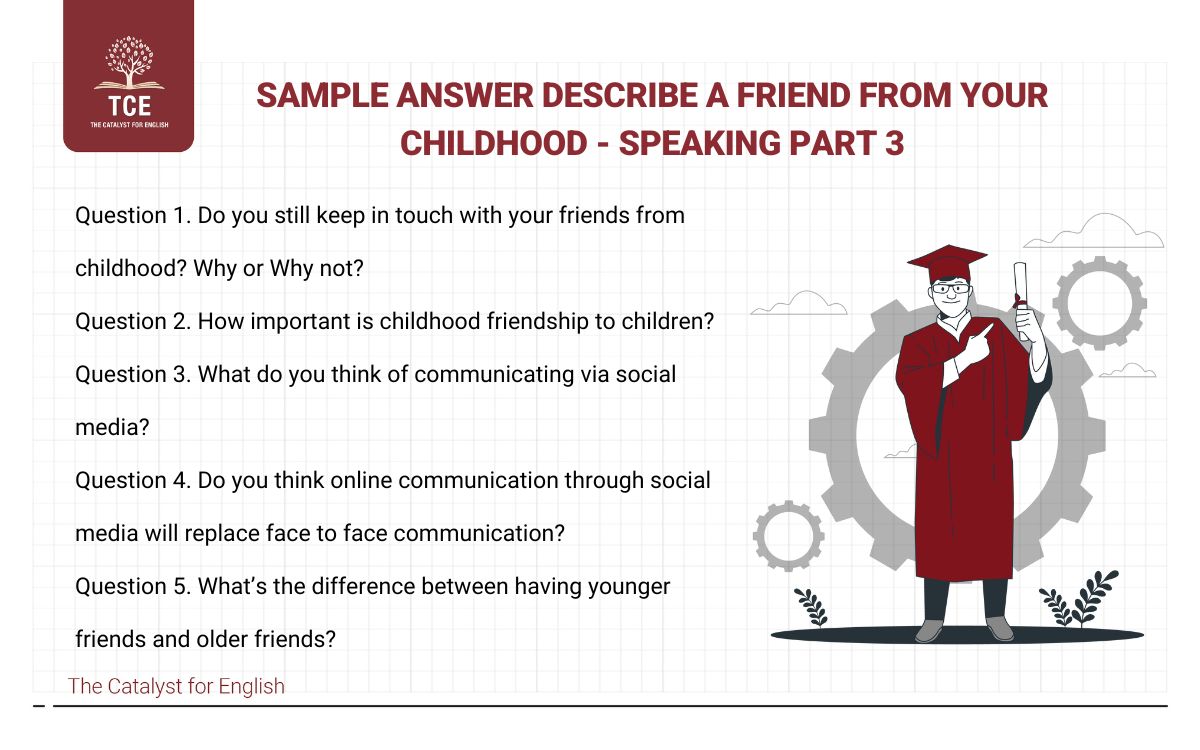
Question 1. Do you still keep in touch with your friends from childhood? Why or Why not?
Yes, I do. Social media makes it easier to stay connected even when people live far apart. We may not talk about every day, but we still share updates, comment on each other’s posts, and sometimes meet during holidays. I think true childhood friends hold a special place in our hearts. They know us in a way that newer friends can’t. However, it’s also normal to lose touch with some people because life gets and priorities change.
Từ vựng ghi điểm:
- Stay connected: Duy trì kết nối
- Hold a special place: Có vị trí đặc biệt
- Lose touch: Mất liên lạc
Question 2. How important is childhood friendship to children?
Childhood friendships are very important because they teach children social skills like sharing, empathy, and cooperation. Friends help them learn how to communicate, handle conflicts, and build trust. These early friendships also provide emotional support, especially when children face challenges at school or home. In many ways, childhood friends help shape our personalities and emotional development.
Từ vựng ghi điểm:
- Empathy: Sự thấu cảm
- Handle conflicts: Xử lý xung đột
- Shape personalities: Hình thành tính cách
Question 3. What do you think of communicating via social media?
Social media is a great tool for staying in touch, especially with friends who live abroad or have busy lives. It allows people to share experiences instantly. However, online communication can sometimes feel superficial. It’s easy to click like or send a message, but that doesn’t always mean you’re maintaining a deep connection. Real friendships still need face to face time and emotional bonding.
Từ vựng ghi điểm:
- Superficial: Hời hợt, nông cạn
- Deep connection: Kết nối sâu sắc
- Emotional bonding: Gắn kết tình cảm
Question 4. Do you think online communication through social media will replace face to face communication?
I don’t think it will ever completely replace face to face interaction. Online communication is convenient, but it lacks emotional warmth like body language, tone of voice or eye contact. In person, conversations are more personal and meaningful. Technology will continue to improve, but real human connection will always matter most.
Từ vựng ghi điểm:
- Face-to-face interaction: Tương tác trực tiếp
- Emotional warmth: Sự ấm áp về cảm xúc
- Completely replace: Thay thế hoàn toàn
Question 5. What’s the difference between having younger friends and older friends?
Younger friends often bring energy, enthusiasm and fresh perspectives, while older friends offer experience and advice. Younger people may help you stay up to date with trends or new ideas, while older friends remind you of long term values. I think it’s healthy to have a mix of both. They each bring something valuable to your life.
Từ vựng ghi điểm:
- Enthusiasm: Sự nhiệt huyết
- Fresh perspectives: Góc nhìn mới mẻ
- Long-term values: Các giá trị lâu dài
Question 6. Has technology changed people’s friendships? How?
Yes, technology has changed friendships dramatically. On one hand, it helps people maintain relationships across distances and reconnect with old friends. On the other hand, it can make friendships more shallow. People might focus on quantity rather than quality. There’s also pressure to appear perfect online, which sometimes creates distance rather than closeness. The best approach is to use technology as a bridge, not a substitute for real interaction.
Từ vựng ghi điểm:
- Dramatically: Một cách đáng kể/mạnh mẽ
- Shallow: Nông cạn, hời hợt
- Quantity rather than quality: Số lượng hơn là chất lượng
- A substitute for: Vật thay thế cho
Question 7. Do you think people today make friends more easily than before?
In some way, yes. Social media and online platforms make it easy to meet new people with similar interests. However, building real trust takes time and personal effort. While making acquaintances has become easier, forming genuine friendships is still as challenging as before.
Từ vựng ghi điểm:
- Acquaintance: Người quen (Xã giao, chưa thân)
- Genuine friendship: Tình bạn đích thực
Question 8. Why do some people lose contact with childhood friends?
There are many reasons for moving to different cities, career paths, or simply growing apart in interests and lifestyles. As we grow older, people focus on studies, work, or family, and friendships sometimes take a back seat. It doesn’t mean the bond disappears, it just changes over time.
Question 9. Do you think friendships are stronger in childhood or adulthood?
That’s an interesting question. I think childhood friendships often feel purer because they’re built on shared play and innocence. Adult friendships, however, are more mature, based on trust, loyalty, and emotional understanding. Both are meaningful, but they fulfill different needs at different stages of life.
Từ vựng ghi điểm:
- Purer: Trong sáng hơn, thuần khiết hơn.
- Innocence: Sự ngây thơ, hồn nhiên
- Fulfill different needs: Đáp ứng những nhu cầu khác nhau
Question 10. How do you think schools can encourage children to build friendships?
Schools can organize group activities, sports, and creative projects that require teamwork. Teachers should also emphasize respect, cooperation, and empathy in the classroom. When children learn to work together, they naturally form bonds that often turn into lasting friendships.
Từ vựng ghi điểm:
- Emphasize: Nhấn mạnh
- Form bonds: Hình thành sự gắn kết
- Lasting friendships: Tình bạn bền vững
Hy vọng rằng qua bài viết này, bạn có thể vận dụng hiệu quả các cấu trúc và từ vựng đã được giới thiệu để xây dựng câu trả lời rõ ràng, mạch lạc hơn, từ đó tối ưu điểm số cho bài thi IELTS Speaking với chủ đề describe a friend from your childhood. Nếu bạn còn bất kỳ thắc mắc nào về nội dung bài học hoặc các khóa học IELTS tại TCE, đừng ngần ngại liên hệ với chúng mình để được hỗ trợ chi tiết nhé.
 thecatalyst.edu.vn