“Describe a place where you thought things were too expensive” thuộc chủ đề Describe a place rất thường xuyên xuất hiện trong bài thi IELTS Speaking, yêu cầu sự kết hợp khéo léo giữa vốn từ vựng chỉ mức giá và trải nghiệm cá nhân. Vậy nên, trong bài viết dưới dưới đây, TCE sẽ cung cấp dàn ý chi tiết cùng bài mẫu đạt chuẩn Band 7.5+ giúp bạn chinh phục tiêu chí Lexical Resource.
I. Phân tích đề bài và cấu trúc bài nói
Chủ đề “Describe a place where you thought things were too expensive” thuộc nhóm chủ đề mô tả trải nghiệm cá nhân kết hợp với đánh giá về giá trị/tiền bạc. Để đạt điểm cao, bạn cần thể hiện được sự tương phản giữa kỳ vọng và thực tế chi phí, đồng thời sử dụng linh hoạt các trạng từ chỉ mức độ để nhấn mạnh cảm xúc.
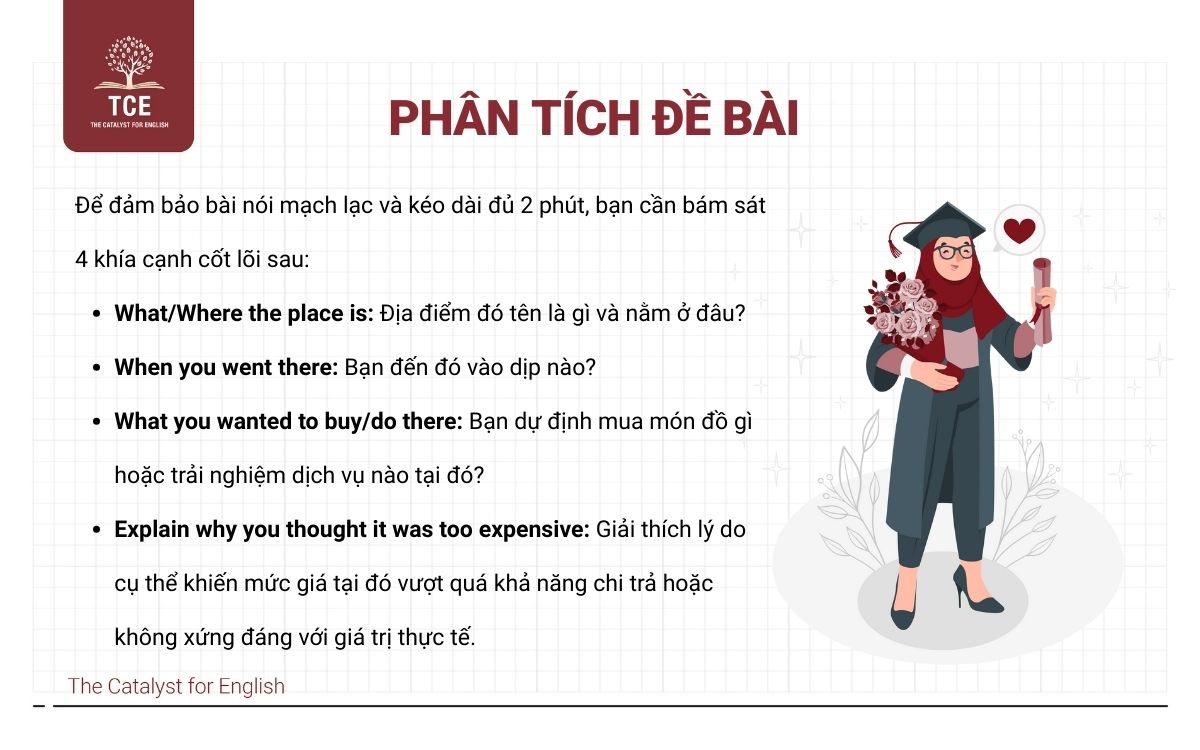
Để đảm bảo bài nói mạch lạc và kéo dài đủ 2 phút, bạn cần bám sát 4 khía cạnh cốt lõi sau:
- What/Where the place is: Địa điểm đó tên là gì và nằm ở đâu (Trong nước hay nước ngoài)?
- When you went there: Bạn đến đó vào dịp nào (Đi du lịch, đi công tác hay vô tình ghé qua)?
- What you wanted to buy/do there: Bạn dự định mua món đồ gì hoặc trải nghiệm dịch vụ nào tại đó?
- Explain why you thought it was too expensive: Giải thích lý do cụ thể khiến mức giá tại đó vượt quá khả năng chi trả hoặc không xứng đáng với giá trị thực tế.
II. Bài mẫu describe a place where you thought things were too expensive part 2
I’m going to talk about Singapore, which is undoubtedly one of the most exorbitant places I’ve ever set foot in. As you may know, this vibrant island nation in Southeast Asia is a global financial hub, but that prosperity comes with a hefty price tag for visitors.
I first traveled there about two years ago with my family. At the time, I had just passed my final exams with flying colors, so my parents decided to reward me with a trip to unwind after a stressful semester. We spent three days and two nights staying at a four-star hotel strategically located near the city center, which served as a perfect base for our exploration.
The reason why I found this place prohibitively expensive was the cost of even the most basic necessities. I distinctly remember being taken aback when I had to pay nearly 3 Singapore dollars for a simple bottle of mineral water at a convenience store – a price that would be considered outrageous in my home country. Furthermore, dining out was a real budget-buster. On average, a decent meal for a family of four would range from 50 to 60 dollars, excluding service charges. Whether it was the entrance fees for world-class attractions or the daily transportation, everything seemed to be priced through the roof.
Looking back, the entire trip cost my parents an arm and a leg. While I truly admired how Singapore transformed into a thriving economic center with impeccable cleanliness and modern infrastructure, the cost of living there was a bit of a culture shock for me. I felt a mix of awe and a slight sense of “price anxiety” throughout the stay. In the future, I would definitely love to revisit this garden city, but only after I have a more substantial budget to fully enjoy what it has to offer without constantly worrying about the bills.
Từ vựng ghi điểm:
| Từ |
Phiên âm |
Ý nghĩa |
| Exorbitant |
/ɪɡˈzɔːrbɪtənt/ |
Quá đắt đỏ, cắt cổ (vượt mức bình thường) |
| A hefty price tag |
/ə ˈhef.ti praɪs tæɡ/ |
Một mức giá rất cao |
| Prohibitively expensive |
/prəˈhɪb.ɪ.tɪv.li ɪkˈspen.sɪv/ |
Đắt đến mức không thể mua được/ngăn cản việc mua |
| Outrageous |
/aʊtˈreɪ.dʒəs/ |
Kỳ quặc, quá mức, không thể chấp nhận được (giá cả) |
| Budget-buster |
/ˈbʌdʒ.ɪt ˌbʌs.tər/ |
Thứ làm “cháy túi” hoặc phá hỏng kế hoạch chi tiêu |
| Priced through the roof |
/praɪst θruː ðə ruːf/ |
Giá tăng cao chạm nóc, cực kỳ đắt |
| Cost an arm and a leg |
/kɒst ən ɑːm ənd ə leɡ/ |
Tốn rất nhiều tiền (thành ngữ phổ biến) |
| Global financial hub |
/ˈɡləʊ.bəl faɪˈnæn.ʃəl hʌb/ |
Trung tâm tài chính toàn cầu |
| Strategically located |
/strəˈtiː.dʒɪ.kəl.i ˈləʊ.keɪ.tɪd/ |
Có vị trí chiến lược, vị trí đắc địa |
| Thriving economic center |
/ˈθraɪ.vɪŋ ˌiː.kəˈnɒm.ɪk ˈsen.tər/ |
Trung tâm kinh tế đang phát triển mạnh mẽ |
| Impeccable cleanliness |
/ɪmˈpek.ə.bəl ˈklen.li.nəs/ |
Sự sạch sẽ hoàn hảo, không chê vào đâu được |
| Modern infrastructure |
/ˈmɒd.ən ˈɪn.frəˌstrʌk.tʃər/ |
Cơ sở hạ tầng hiện đại |
| With flying colors |
/wɪð ˈflaɪ.ɪŋ ˈkʌl.ərz/ |
(Vượt qua kỳ thi) với điểm số cao rực rỡ |
| Taken aback |
/ˈteɪ.kən əˈbæk/ |
Ngạc nhiên, sửng sốt (thường là bất ngờ tiêu cực) |
| A mix of awe |
/ə mɪks əv ɔː/ |
Một sự kinh ngạc, vừa ngưỡng mộ vừa sợ hãi |
| Substantial budget |
/səbˈstæn.ʃəl ˈbʌdʒ.ɪt/ |
Một nguồn ngân sách lớn, dư dả |
III. Từ vựng và cấu trúc ghi điểm với đề describe a place
Việc thay thế các từ đơn giản như “very expensive” bằng các từ vựng học thuật hoặc thành ngữ sẽ giúp bạn nâng band điểm một cách nhanh chóng. Cụ thể như sau:
| Từ |
Ý nghĩa |
| Exorbitant |
Mức giá cao cắt cổ, phi lý |
| Prohibitive |
Đắt đến mức ngăn cản người ta mua sắm hoặc làm gì đó |
| Cost a fortune |
Tốn cả một gia tài, rất nhiều tiền |
| Break the bank |
Thường dùng ở dạng phủ định (won’t break the bank) để chỉ món đồ không quá đắt, nhưng trong ngữ cảnh này bạn có thể nói: “It really broke my bank”. |
| Through the roof |
Giá tăng vọt, cao chạm nóc |
| Opulent |
Sang trọng, hào nhoáng, thường dùng cho kiến trúc và nội thất |
| Glitz and glamour |
Sự lộng lẫy và hào nhoáng (thường nói về lối sống hoặc các khu vực ăn chơi thượng lưu). |
| Upscale |
Cao cấp, dành cho giới thượng lưu |
| Mind-blowing |
Gây sốc, gây ngạc nhiên cực độ (có thể dùng cho cả mức giá hoặc sự lộng lẫy). |
| Out of place |
Cảm thấy lạc lõng, không thuộc về nơi đó |
| Pay a premium |
Phải trả một mức giá cao hơn bình thường |
| Beyond one’s means |
Vượt quá khả năng chi trả của ai đó |
| Fork out (phrasal verb) |
Miễn cưỡng phải trả một khoản tiền lớn cho thứ gì |
| Value for money |
Đáng đồng tiền bát gạo |
Nếu bạn muốn nâng band IELTS nhanh chóng, khóa luyện thi IELTS tại TCE sẽ giúp bạn cải thiện từ 0,5 đến 1 band nhờ lộ trình học rõ ràng và chương trình được xây dựng bài bản. Bên cạnh đó, bạn có thể đăng ký thi thử IELTS tại TCE để làm quen với format đề, rèn kỹ năng phân bổ thời gian và tự tin hơn trước kỳ thi chính thức.
IV. Bài mẫu describe a place where you thought things were too expensive part 3
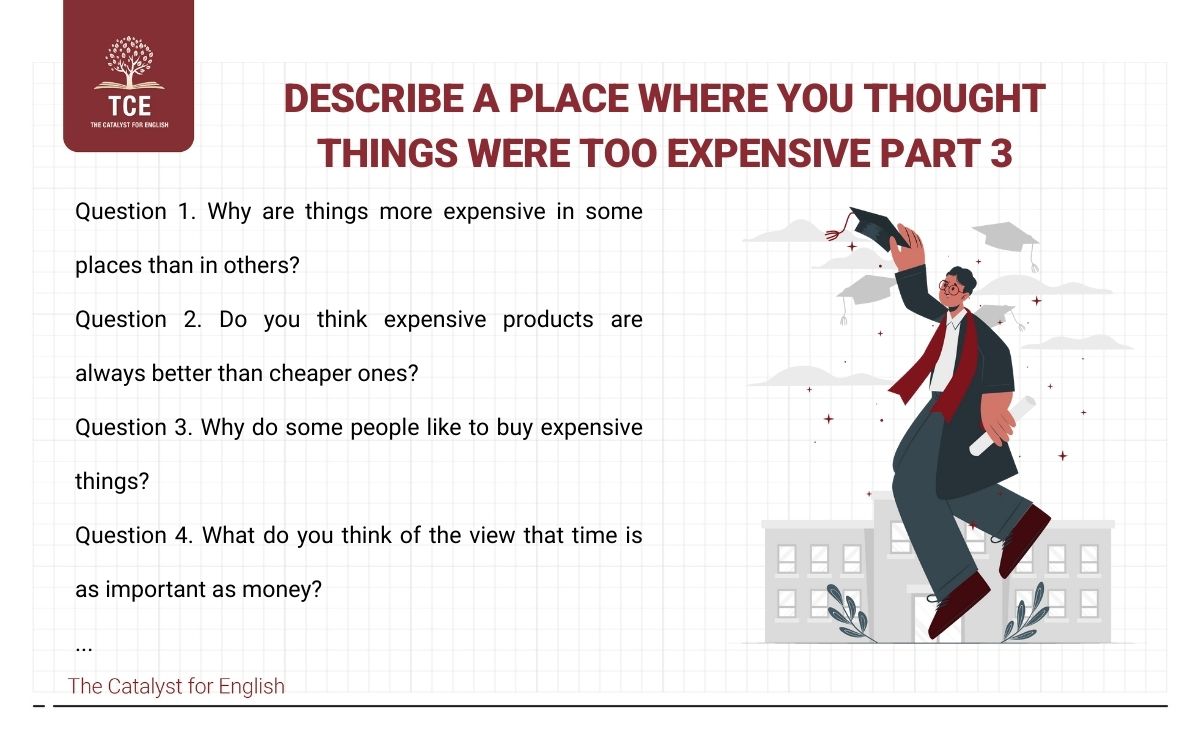
Question 1. Why are things more expensive in some places than in others?
Personally, I believe the price disparity boils down to two primary factors: operating costs and branding. In prime locations like city centers, businesses have to deal with exorbitant rents and higher labor costs, which are ultimately passed on to the customers. A clear example is Singapore, where a simple meal costs much more than in Vietnam due to the high cost of living. Additionally, some places charge a premium for the prestige and exclusive atmosphere they provide, rather than just the product itself.
Question 2. Do you think expensive products are always better than cheaper ones?
Not necessarily, as the higher price tag doesn’t always guarantee superior quality. In many cases, people are simply paying for the brand prestige and marketing costs rather than the actual durability of the product. For instance, a basic white T-shirt from a luxury label can cost ten times more than one from a high-street brand, yet their quality might be identical. That being said, for technical goods like electronics, investing in a pricier item often means better safety standards and longevity, which can be more economical in the long run.
Question 3. Why do some people like to buy expensive things?
From my perspective, people gravitate towards luxury items mainly to assert their social status and gain a sense of accomplishment. Owning a high-end product often serves as a status symbol, showing others that they have achieved a certain level of financial success. Besides, many consumers prioritize durability and craftsmanship, believing that “you get what you pay for,” so they prefer investing in one expensive but long-lasting item rather than multiple cheap ones. Ultimately, it is often a mix of seeking public recognition and personal satisfaction.
Question 4. What do you think of the view that time is as important as money?
I totally subscribe to the view that time and money are equally indispensable in our lives. While money provides us with the means to cover our basic needs and enjoy a comfortable lifestyle, time is a finite resource that, once spent, can never be recovered. For instance, a high-paying job is meaningless if one is too burnt out to spend quality time with family. Therefore, achieving a work-life balance is crucial, as money can buy luxury goods, but it certainly cannot buy back lost moments or health.
Question 5. Is it more important to choose a job with a high salary or with more time off?
In my opinion, the choice between a high salary and more time off depends largely on an individual’s priorities at different stages of life. For young professionals, a lucrative income might be more appealing as it provides financial security and the means to invest in their future. However, as people get older, they often value leisure time more to avoid being overworked and to maintain their mental well-being. Ultimately, I believe a decent salary is essential, but not at the expense of one’s health or the ability to enjoy life with loved ones.
Question 6. Why do some people still use cash?
Despite the rise of digital payments, many people still stick to cash because of its tangibility and ease of use in certain situations. For elderly people, who might not be tech-savvy, physical money is much more straightforward and reliable than complex banking apps. Furthermore, in many local markets or small street vendors, cash remains the primary mode of transaction as it doesn’t require any special equipment. Finally, using cash can help individuals keep track of their spending more effectively, as they can physically see the money leaving their wallets.
Question 7. How important is it to have a variety of payment options?
Having a wide range of payment methods is absolutely vital in today’s fast-paced world as it enhances the overall customer experience. By offering various options like credit cards, e-wallets, or cash, businesses can accommodate the different preferences and technical skills of their clients. For instance, tourists often prefer international cards, while locals might favor contactless payments for speed. Ultimately, providing flexibility not only ensures convenience for shoppers but also helps businesses maximize their sales by not turning away potential customers who don’t carry a specific form of payment.
Vậy là The Catalyst for English đã cùng các bạn phân tích chi tiết dàn ý, từ vựng ghi điểm và bài mẫu Band 7.5+ cho đề bài Describe a place where you thought things were too expensive. Hy vọng rằng, với những chia sẻ và chiến thuật trả lời Part 3 chuyên sâu trên, TCE đã giúp bạn tự tin chinh phục chủ đề về chi phí và tiền bạc này một cách dễ dàng nhất! Đừng quên theo dõi thường xuyên chuyên mục IELTS Speaking để cập nhật thêm nhiều bài mẫu và cấu trúc ăn điểm nhé!
 thecatalyst.edu.vn