Bạn đã bao giờ cảm thấy lúng túng khi gặp một chủ đề quá rộng lớn như “describe a time when you learn something new” trong phòng thi IELTS Speaking? Dù đây là một chủ đề thường xuyên xuất hiện trong bộ đề dự báo, nhưng để đạt được Band 7.0+, bạn không chỉ cần một câu chuyện hay mà còn cần vốn từ vựng học thuật và cách triển khai mạch lạc. Trong bài viết này, The Catalyst for English sẽ hướng dẫn bạn cách xây dựng dàn ý chi tiết cùng bài mẫu cực kỳ tự nhiên giúp bạn ghi điểm tuyệt đối với giám khảo.
I. Phân tích đề bài Describe a time when you learn something new
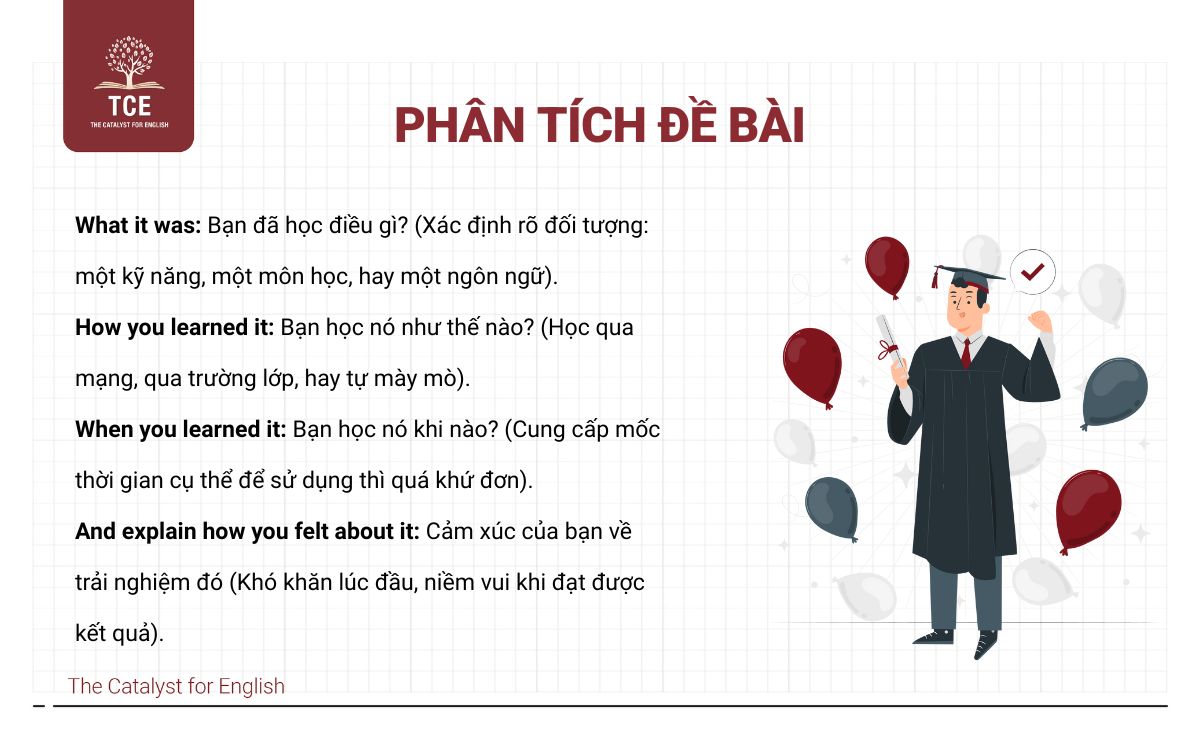
Khi nhận được Cue Card từ giám khảo, bạn sẽ có 1 phút chuẩn bị. Đề bài thường đi kèm với 4 câu hỏi gợi ý mà bạn bắt buộc hoặc nên bám sát để đảm bảo tính mạch lạc (Coherence):
- What it was: Bạn đã học điều gì? (Xác định rõ đối tượng: một kỹ năng, một môn học, hay một ngôn ngữ).
- How you learned it: Bạn học nó như thế nào? (Học qua mạng, qua trường lớp, hay tự mày mò).
- When you learned it: Bạn học nó khi nào? (Cung cấp mốc thời gian cụ thể để sử dụng thì quá khứ đơn).
- And explain how you felt about it: Cảm xúc của bạn về trải nghiệm đó (Khó khăn lúc đầu, niềm vui khi đạt được kết quả).
Lưu ý: Bạn không nên trả lời từng câu hỏi như đang thẩm vấn mà nên sử dụng các từ nối như “Initially”, “Moving on to how I acquired this skill”, hay “Looking back” để tạo thành một dòng chảy câu chuyện tự nhiên.
II. Danh mục từ vựng ăn điểm cho chủ đề Learning
Việc sử dụng chính xác các nhóm từ dưới đây sẽ giúp bạn nâng Band điểm từ 6.0 lên 7.5+ một cách thuyết phục.
| Từ |
Ý nghĩa |
| Pick up a skill |
Học một kỹ năng mới một cách tự nhiên (thường là qua thực tế, không qua trường lớp bài bản). |
| Delve into something |
Nghiên cứu sâu, tìm hiểu kỹ lưỡng về một lĩnh vực nào đó |
| Get the hang of it |
Dần nắm bắt được cách làm, bắt đầu quen tay với một việc gì đó |
| Master the art of [something] |
Tinh thông, bậc thầy trong nghệ thuật/kỹ năng gì đó |
| Hone a skill |
Mài giũa, rèn luyện kỹ năng để trở nên sắc bén hơn |
| Absorb knowledge |
Tiếp thu kiến thức |
| A steep learning curve |
Một khoảng thời gian khó khăn khi bắt đầu học một thứ gì đó hoàn toàn mới |
| Intricate / Sophisticated |
Phức tạp, tinh vi (dùng thay cho “very hard”) |
| Rudimentary / Basic |
Sơ đẳng, cơ bản (dùng thay cho “easy”) |
| Daunting |
Làm nản chí, gây choáng ngợp |
| Mind-blowing |
Gây kinh ngạc, mở mang tầm mắt |
| Rewarding / Fulfilling |
Đáng công sức, mang lại cảm giác thỏa mãn về mặt tinh thần |
| Trial and error |
Quá trình thử và sai (học từ những lần thất bại) |
| Practice makes perfect |
Có công mài sắt có ngày nên kim |
| Every cloud has a silver lining |
Trong cái rủi có cái may |
| An eye-opener |
Một trải nghiệm giúp mở mang tầm mắt |
| Burn the midnight oil |
Thức khuya để học tập/làm việc |
| Back to square one |
Trở lại vạch xuất phát |
III. Bài mẫu Describe a time when you learn something new part 2
To be honest, I’ve always considered myself a bit of a clumsy person when it comes to manual work. However, a particularly memorable experience of learning something new was when I delved into the art of making Christmas crafts about two years ago.
It happened during the holiday season when I stumbled upon an online magazine called Mihira Christmas DIY. I was immediately captivated by their creative holiday ideas. Although I had always been intrigued by handmade decorations, I’d never actually had a crack at making them myself. That year, driven by a desire to add a personal touch to my home, I decided to give it a whirl.
The blog was incredibly comprehensive, providing step-by-step instructions. It was almost like having a virtual mentor. I started with some rudimentary tasks, such as crafting delicate paper snowflakes, just to get the hang of it. Once I felt more confident, I graduated to more intricate projects, like assembling a festive wreath from scratch using pinecones and ribbons. It was a classic case of trial and error, but the video demonstrations were a lifesaver.
The whole experience was immensely rewarding. As I watched each piece take shape, I felt a profound sense of accomplishment. It gave me a new appreciation for the painstaking effort behind handmade items. Moreover, it was a great way to unwind and escape the hustle and bustle of daily life. Decorating the house with my family using my own creations brought an added sense of conviviality and joy. Looking back, it wasn’t just about the crafts; it was about rediscovering my own creativity.
Từ vựng ghi điểm:
| Từ |
Phiên âm |
Ý nghĩa |
| Clumsy |
/ˈklʌmzi/ |
Vụng về |
| Stumble upon |
/ˈstʌmbl əˈpɒn/ |
Tình cờ bắt gặp |
| Captivated |
/ˈkæptɪveɪtɪd/ |
Bị cuốn hút |
| Comprehensive |
/ˌkɒmprɪˈhensɪv/ |
Toàn diện, chi tiết |
| Rudimentary |
/ˌruːdɪˈmentri/ |
Sơ đẳng, cơ bản |
| Immensely |
/ɪˈmensli/ |
Cực kỳ, vô cùng |
| Sense of accomplishment |
/sens əv əˈkʌmplɪʃmənt/ |
Cảm giác thành tựu |
| Painstaking |
/ˈpeɪnzteɪkɪŋ/ |
Tỉ mỉ, tốn nhiều công sức |
| Hustle and bustle |
/ˈhʌsl ənd ˈbʌsl/ |
Sự hối hả và nhộn nhịp |
| Conviviality |
/kənˌvɪviˈæləti/ |
Sự ấm cúng, vui vẻ thân tình |
IV. Bài mẫu Describe a time when you learn something new part 3
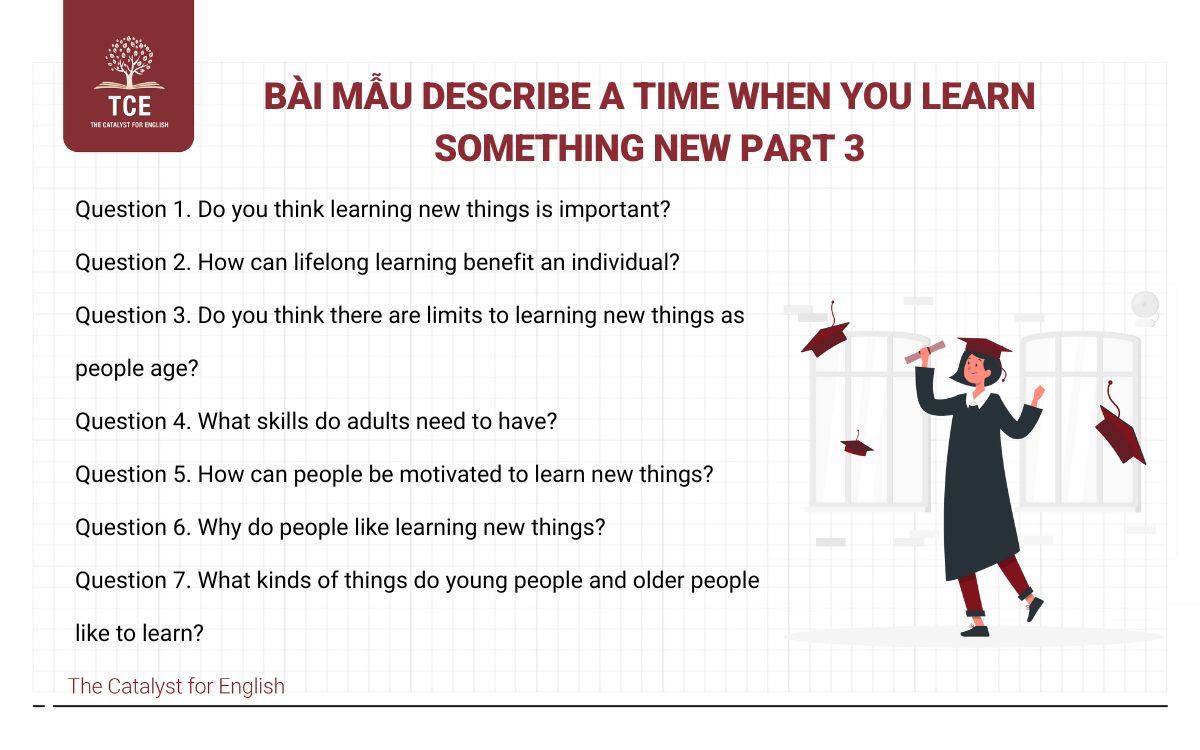
Question 1. Do you think learning new things is important?
Absolutely. Constant learning is the key to personal growth and adaptability in this rapidly changing world. It not only broadens our horizons but also keeps our minds sharp and agile. Without acquiring new knowledge, an individual risks becoming obsolete, especially in a competitive labor market where new technologies emerge every day.
Question 2. How can lifelong learning benefit an individual?
Lifelong learning offers profound cognitive and professional advantages. Mentally, it has been proven to stave off cognitive decline and diseases like Alzheimer’s by keeping the brain engaged. Career-wise, a commitment to continuous education allows people to up-skill or re-skill, ensuring they remain relevant and capable of seizing new opportunities throughout their lives.
Question 3. Do you think there are limits to learning new things as people age?
While it is scientifically true that neuroplasticity decreases with age, making it slightly harder to grasp complex concepts quickly, I don’t believe there are absolute limits. Older adults possess a wealth of experience and wisdom that can help them connect new information to existing knowledge. With persistence and the right methodology, senior citizens can certainly master new languages or digital tools.
Question 4. What skills do adults need to have?
In the modern era, I would argue that digital literacy and emotional intelligence are paramount. As most professional and personal interactions have migrated online, being tech-savvy is no longer optional. Furthermore, soft skills like critical thinking and stress management are crucial for navigating the complexities of adult life and maintaining healthy relationships in a high-pressure environment.
Question 5. How can people be motivated to learn new things?
Motivation often stems from a combination of intrinsic curiosity and extrinsic rewards. For instance, companies can incentivize employees by offering promotions or bonuses for completing professional certifications. On a personal level, making learning gamified or community-based can foster a sense of enjoyment and healthy competition, which encourages people to stick with their goals.
Question 6. Why do people like learning new things?
Primarily, it’s about the sense of accomplishment and the “Eureka” moment when a difficult concept finally clicks. Humans are naturally inquisitive creatures, and satisfying that curiosity provides a significant dopamine hit. Additionally, learning often serves as a form of escapism or a way to discover hidden talents that can lead to a more fulfilling lifestyle.
Question 7. What kinds of things do young people and older people like to learn?
There is usually a distinct contrast in their preferences. The younger generation tends to gravitate towards cutting-edge technology, social media trends, or academic subjects that enhance their career prospects. Conversely, older individuals often find solace in leisure-based learning, such as gardening, history, or traditional crafts, focusing more on personal enrichment and heritage.
Question 8. Do you think people learn better alone or with others?
This largely depends on an individual’s learning style. Studying alone allows for deep focus and a personalized pace, which is ideal for introverts or complex theoretical work. However, collaborative learning fosters peer-to-peer feedback and diverse perspectives, which are essential for developing communication skills and solving multifaceted problems in a team environment.
Question 9. How has technology changed the way people learn nowadays?
Technology has completely democratized education. High-quality resources that were once confined to elite universities are now accessible to anyone with an internet connection through platforms like Coursera or YouTube. Furthermore, the advent of Artificial Intelligence has enabled personalized learning paths, allowing students to receive instant feedback and support tailored to their specific weaknesses.
Question 10. Should schools focus more on teaching practical skills?
I firmly believe a balanced curriculum is necessary. While theoretical knowledge provides the foundational framework for understanding the world, practical skills like financial literacy, coding, or basic home maintenance are what students actually need to survive post-graduation. Integrating more hands-on projects would better prepare the youth for the pragmatic challenges of the real world.
Trên đây là những gợi ý chi tiết về từ vựng và bài mẫu giúp bạn trả lời câu hỏi “Describe a time when you learn something new” một cách tự nhiên và thuyết phục hơn trong IELTS Speaking. Hãy nhớ rằng, chìa khóa của sự thành công là “practice makes perfect” – hãy luyện tập ghi âm và hiệu chỉnh bài nói của mình mỗi ngày.
Để cải thiện toàn diện các kỹ năng và xây dựng lộ trình nâng band điểm bài bản, bạn cũng có thể cân nhắc tham gia các khóa học luyện thi IELTS chuyên sâu tại The Catalyst for English để nhận được sự hỗ trợ trực tiếp từ các giảng viên chuyên gia.
 thecatalyst.edu.vn