“Describe an exciting journey you once took” là một trong những chủ đề kinh điển và thường xuyên xuất hiện nhất trong kỳ thi IELTS Speaking Part 2. Tuy nhiên, để biến một chuyến đi bình thường thành một câu chuyện “exciting” (thú vị) và ghi điểm tuyệt đối trong mắt giám khảo không phải là điều dễ dàng. Trong bài viết này, TCE sẽ cung cấp cho bạn dàn ý chi tiết, kho từ vựng “ăn điểm” theo chủ đề Travel và bài mẫu Band 7.5+ giúp bạn tự tin làm chủ bài nói của mình.
I. Phân tích đề bài và cấu trúc dàn ý
Trong IELTS Speaking Part 2, việc bám sát các gợi ý trên thẻ câu hỏi gợi ý (Cue Card) là điều kiện cần, nhưng việc mở rộng ý tưởng một cách logic mới là điều kiện đủ để chạm đến Band 7.0+.
1.1. Phân tích yêu cầu của đề bài (Task Response)
Với đề bài “Describe an exciting journey you once took”, bạn cần đặc biệt lưu ý đến các từ khóa quan trọng sau để không bị lạc đề:
“Exciting”: Đây là tính từ trọng tâm. Chuyến đi không chỉ đơn thuần là di chuyển, nó phải mang lại cảm giác phấn khích, hào hứng hoặc có những tình tiết bất ngờ.
“Journey”: Tập trung vào quá trình di chuyển (hành trình) nhiều hơn là chỉ mô tả địa điểm đến (destination).
“Once took”: Đề bài sử dụng thì quá khứ, vì vậy bạn phải sử dụng nhất quán các thì quá khứ (Past Simple, Past Continuous, Past Perfect) trong suốt bài nói.
Các câu hỏi gợi ý thường gặp:
Where you went?
How you travelled?
Who you went with?
And explain why it was exciting.
1.2. Cấu trúc 4 bước triển khai câu trả lời
Để đảm bảo bài nói mạch lạc và duy trì được độ dài 2 phút mà không bị lặp ý, dưới đây là dàn ý mà TCE gợi ý:
Bước 1: Introduction & Context (Mở đầu và bối cảnh)
Giới thiệu trực tiếp về chuyến đi.
Sử dụng các cụm từ dẫn dắt như: “I’m a real travel enthusiast, so I’ve been on numerous trips, but today I’d like to talk about…”
Bước 2: Chi tiết hành trình
Mô tả phương tiện (đi du lịch bằng xe máy, tàu hỏa, hay chuyến bay đường dài).
Thời gian diễn ra và người đồng hành – đây là lúc bạn chèn các từ vựng có chủ đề scenery (phong cảnh) hoặc transportation (phương tiện di chuyển).
Bước 3: The “Exciting” Climax (Tình tiết thú vị)
Kể về một sự kiện cụ thể khiến chuyến đi trở nên đặc biệt: một lễ hội địa phương bạn tình cờ gặp, một sự cố hỏng xe nhưng gặp được người tốt, hay cảm giác chinh phục được đỉnh núi cao.
Bạn nên sử dụng các cụm từ mô tả cảm xúc như: “Unbelievably,” “Out of the blue,” “To my surprise.”
Bước 4: Feelings & Reflection (Cảm xúc và suy ngẫm sau chuyến đi)
Tóm tắt lại ý nghĩa của chuyến đi đối với bản thân.
Kết bài bằng một câu khẳng định, ví dụ: “If I had a chance, I would definitely retrace my steps to experience that thrill again.”
2. Từ vựng ăn điểm chủ đề Exciting Journey
Việc sử dụng từ vựng đúng ngữ cảnh là yếu tố tiên quyết để giám khảo đánh giá bạn ở mức Band 7.0+.
2.1. Nhóm từ vựng mô tả phương tiện, cảm xúc
Thay vì chỉ nói “go by car” hay “beautiful road”, bạn hãy sử dụng:
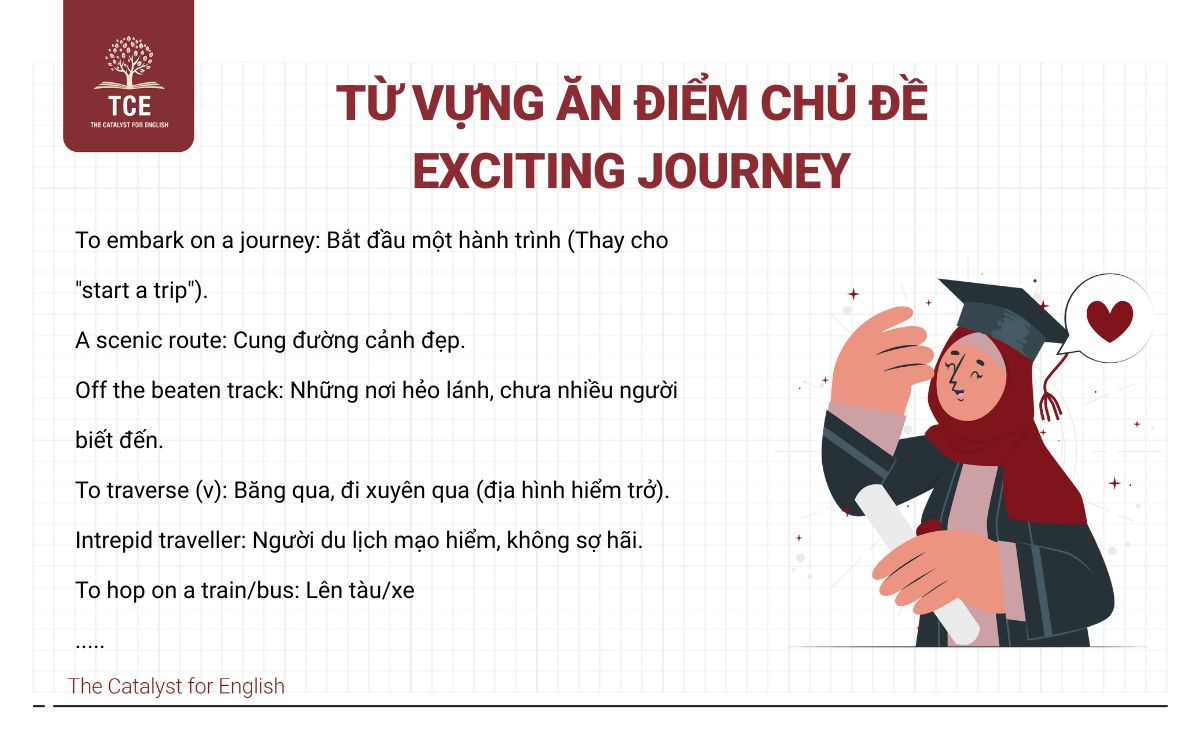
To embark on a journey: Bắt đầu một hành trình (Thay cho “start a trip”).
A scenic route: Cung đường cảnh đẹp.
Off the beaten track: Những nơi hẻo lánh, chưa nhiều người biết đến.
To traverse (v): Băng qua, đi xuyên qua (địa hình hiểm trở).
Intrepid traveller: Người du lịch mạo hiểm, không sợ hãi.
To hop on a train/bus: Lên tàu/xe
Breathtaking/Stunning landscapes: Phong cảnh đẹp đến ngạt thở.
Để nhấn mạnh cảm xúc của chuyến đi, bạn có thể dùng:
To be over the moon: Cực kỳ hạnh phúc, sung sướng.
An adrenaline rush: Một sự hưng phấn tột độ (thường dùng khi tham gia trò chơi mạo hiểm hoặc trải nghiệm kịch tính).
To broaden my horizons: Mở rộng tầm mắt/kiến thức.
A once-in-a-lifetime experience: Trải nghiệm cả đời chỉ có một lần.
To be mesmerized by…: Bị mê hoặc/quyến rũ bởi…
To immerse oneself in local culture: Đắm mình vào văn hóa địa phương.
Unforgettable memories: Những kỷ niệm không thể nào quên.
2.2. Các cấu trúc ngữ pháp ghi điểm
Giám khảo sẽ tìm kiếm sự linh hoạt trong việc kết hợp các thì và cấu trúc câu đặc biệt:
Sử dụng câu điều kiện loại 3 (để mô tả cảm xúc Hy vọng/Tiếc nuối): Ví dụ: “If I hadn’t taken that trip, I wouldn’t have realized how beautiful my country is.” (Nếu tôi không đi chuyến đó, tôi đã không nhận ra đất nước mình đẹp đến nhường nào).
Cấu trúc Đảo ngữ (Inversion) để nhấn mạnh: Ví dụ: “Never had I seen such a majestic waterfall before.” (Chưa bao giờ tôi được tận mắt chứng kiến một thác nước hùng vĩ đến thế).
Mệnh đề quan hệ không xác định: Ví dụ: “We visited Ha Giang, which is famous for its rugged mountains and unique ethnic cultures.” (Chúng tôi thăm Hà Giang, nơi vốn nổi tiếng với những dãy núi đá tai mèo và văn hóa dân tộc độc đáo).
Sử dụng thì quá khứ hoàn thành (Past Perfect) để kể chuyện: Dùng để mô tả một sự kiện xảy ra trước một sự kiện khác trong hành trình nhằm tạo sự logic về thời gian.
3. Bài mẫu describe an exciting journey you once took – IELTS Speaking Part 2
To be honest, I’m a real travel enthusiast, and I’ve embarked on numerous trips across Vietnam, but if I had to pick the most exhilarating one, it would definitely be my journey to Ha Giang, a mountainous province in the North, about two years ago. I decided to go on this adventure with a couple of my kindred spirits-close friends who share the same passion for exploring off-the-beaten-track destinations. The journey was quite a challenge as we opted to travel by motorbike to fully immerse ourselves in the natural beauty of the region. We traversed winding roads and incredibly steep passes, like the legendary Ma Pi Leng. The scenery was absolutely breath-taking, with majestic limestone mountains and vast buckwheat flower fields that seemed to stretch on forever. Out of the blue, on our second day, one of our bikes had a flat tire in a very remote area with no repair shops in sight. We were initially panicked, but to our surprise, a local ethnic man appeared and helped us fix it with incredible hospitality. This heart-warming encounter became the highlight of the trip, teaching us a great lesson about human kindness. The reason this journey was so exciting is twofold: it gave me a massive adrenaline rush to conquer those dangerous bends, and it was a once-in-a-lifetime experience that truly broadened my horizons about the cultural diversity of my country. Looking back, I realize that the thrill didn’t just come from the stunning landscapes, but also from the sense of resilience we built along the way. I felt over the moon when we finally reached the Lung Cu Flag Tower, and that sense of achievement is something I will cherish forever. It was a journey that challenged my limits and left an indelible mark on my soul.
Từ vựng ghi điểm:
Từ
Ý nghĩa
Embark on a journey
Bắt đầu/dấn thân vào một hành trình (Thay cho: Start a trip)
Off-the-beaten-track destinations
Những địa điểm hẻo lánh, ít người biết đến
The legendary [Name]
[Cái tên] huyền thoại (Dùng để nhấn mạnh sự nổi tiếng của địa danh)
Retrace my steps
Đi lại con đường cũ/trải nghiệm lại hành trình cũ
Traverse winding roads
Băng qua những con đường quanh co
Incredibly steep passes
Những con đèo dốc cực kỳ hiểm trở
Breath-taking scenery
Phong cảnh đẹp đến ngạt thở (Thay cho: Beautiful view)
Majestic limestone mountains
Những dãy núi đá vôi hùng vĩ
Stretch on forever
Trải dài vô tận
Kindred spirits
Những tâm hồn đồng điệu (Thay cho: Close friends)
Immerse ourselves in
Đắm mình vào… (văn hóa, thiên nhiên)
A massive adrenaline rush
Một sự hưng phấn tột độ
Broaden my horizons
Mở rộng tầm mắt/kiến thức
Over the moon
Cực kỳ hạnh phúc
Out of the blue
Bất thình lình/Bỗng nhiên (Thay cho: Suddenly)
Heart-warming encounter
Cuộc gặp gỡ ấm lòng
Incredible hospitality
Sự hiếu khách tuyệt vời
Left an indelible mark on my soul
Để lại một dấu ấn không thể xóa nhòa trong tâm hồn
IV. Bài mẫu describe an exciting journey you once took – IELTS Speaking Part 3
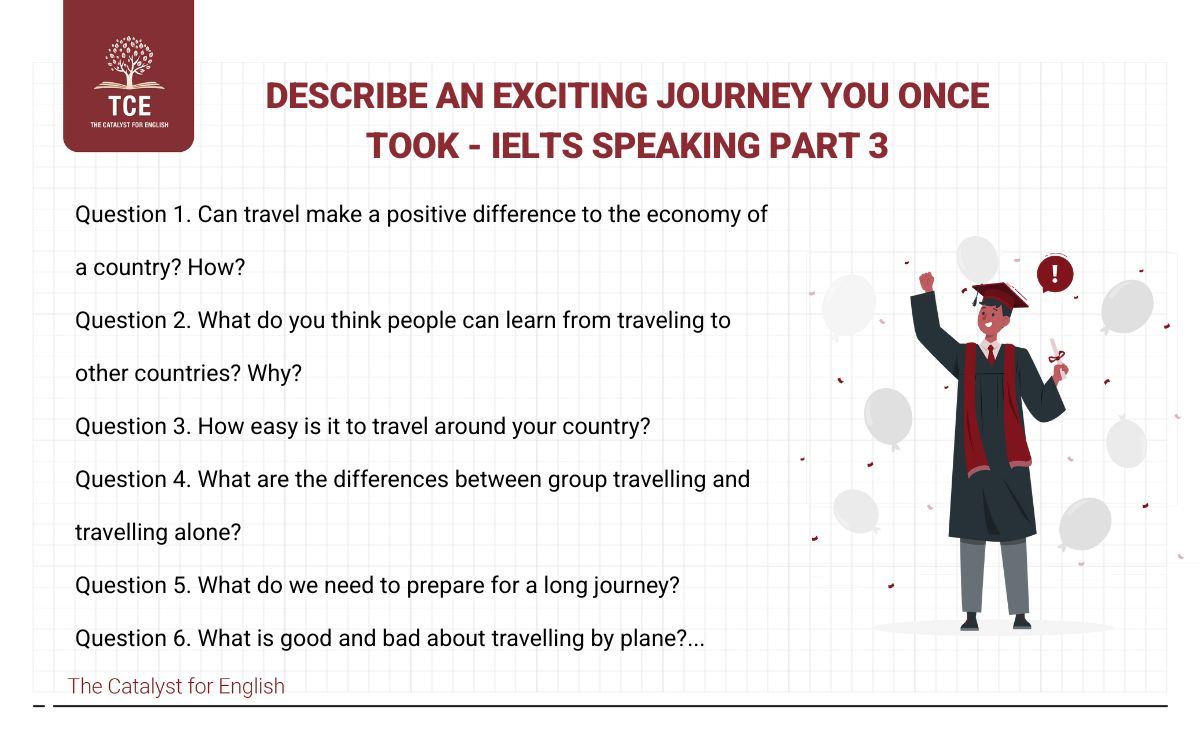
Question 1. Can travel make a positive difference to the economy of a country? How?
Certainly! Traveling can undoubtedly bolster a nation’s economy, primarily by creating a multipliers effect across various sectors. Firstly, it generates a significant number of jobs in hospitality, transportation, and retail, which helps lower unemployment rates. Furthermore, the influx of foreign currency from international tourists provides a vital source of revenue that governments can reinvest into infrastructure development and the preservation of cultural heritage.
Question 2. What do you think people can learn from traveling to other countries? Why?
Traveling to other countries offers a profound opportunity for cultural immersion, allowing individuals to foster a more open-minded perspective by witnessing diverse lifestyles firsthand. Furthermore, it serves as a practical way to enhance interpersonal skills and adaptability as travelers navigate unfamiliar environments and overcome language barriers. Ultimately, these experiences broaden one’s horizons, helping people move beyond stereotypes and develop a more nuanced understanding of the global community.
Question 3. How easy is it to travel around your country?
Traveling around Vietnam has become significantly more convenient due to the rapid expansion of the transport infrastructure, including a comprehensive network of budget airlines and modernized highways. However, the ease of travel can vary depending on the terrain; while coastal cities are easily accessible, navigating the rugged mountainous regions in the North still poses a challenge for many. Overall, with the rise of ride-hailing apps and improved public transit, exploring the country is now more feasible and hassle-free than ever before.
Question 4. What are the differences between group travelling and travelling alone?
Travelling alone offers unparalleled autonomy, allowing individuals to tailor their itinerary to personal whims and foster self-reliance through navigating unfamiliar territories independently. In contrast, group travel prioritizes social cohesion and shared experiences, often providing a sense of security and being more cost-effective as expenses are divided among members. Ultimately, the choice hinges on whether one seeks the thrill of solitude and self-discovery or the comfort and camaraderie found in collective exploration.
Question 5. What do we need to prepare for a long journey?
For a prolonged expedition, meticulous preparation is paramount, starting with a well-thought-out itinerary and ensuring all essential travel documents are in order. Furthermore, one must prioritize physical well-being by packing a basic medical kit and selecting appropriate gear that caters to the specific climatic conditions of the destination. Ultimately, maintaining a degree of flexibility and having a financial contingency plan are crucial to navigating any unforeseen circumstances that may arise during the journey.
Question 6. What is good and bad about travelling by plane?
Air travel is widely regarded for its unrivalled efficiency, enabling passengers to traverse vast distances in a fraction of the time required by other modes of transport. However, this convenience is often offset by its significant carbon footprint and the physical discomfort of jet lag or cramped seating on long-haul flights. Ultimately, while aviation offers global connectivity, it remains a relatively costly and environmentally taxing way to explore the world.
Question 7. Why do some people prefer to travel in their own country rather than going abroad?
Domestic travel is often preferred due to its affordability and the absence of complex logistical hurdles like visa applications or significant language barriers. Furthermore, many individuals feel a strong desire to explore their own cultural heritage and support the local economy before venturing into unfamiliar international territories. Ultimately, staying within one’s borders offers a sense of familiarity and convenience, allowing for more spontaneous and stress-free vacations.
Question 8. Why are more and more young people going on long trips nowadays?
Many young people today are gravitating toward prolonged expeditions as they view them as a transformative experience to escape the monotony of modern life and discover their true selves. This trend is further fueled by the rise of remote work and digital nomadism, which allow the younger generation to maintain their livelihoods while exploring the globe. Ultimately, the influence of social media has created a digital wanderlust, inspiring youth to seek out unique experiences that broaden their horizons and enhance their cross-cultural competency.
Question 9. Why do some people prefer long journeys?
Many individuals are drawn to prolonged journeys because they offer a profound sense of escapism, allowing them to fully detach from the stresses of daily life and find mental clarity. Unlike short trips, extended travel provides the necessary time for deep cultural immersion, enabling travelers to form meaningful connections with local communities rather than just scratching the surface. Ultimately, such journeys are often viewed as a transformative rite of passage, fostering personal growth, resilience, and a broader perspective on the world.
V. Đăng ký thi thử IELTS 4 kỹ năng tại TCE
Dù nắm vững kiến thức, nhiều bạn vẫn dễ mất bình tĩnh trước áp lực phòng thi thật, khiến mọi nỗ lực trở nên kém hiệu quả.
Hiểu điều đó, TCE không chỉ trang bị kiến thức mà còn giúp bạn rèn bản lĩnh qua các kỳ thi thử định kỳ, dưới sự đồng hành của đội ngũ giảng viên IELTS 8.0+ giàu kinh nghiệm, từng hỗ trợ hàng ngàn học viên đạt mục tiêu.
Bạn có thể bắt đầu với kỳ thi thử IELTS 4 kỹ năng để được chuyên gia trực tiếp phân tích lỗi sai và định hướng cải thiện. Khi đã sẵn sàng bứt phá, các khóa học IELTS cam kết đầu ra tại TCE sẽ giúp bạn chinh phục mục tiêu một cách bài bản và hiệu quả.
Vậy là chúng ta đã cùng TCE phân tích ý tưởng, triển khai dàn ý và hoàn thiện bài mẫu cho chủ đề Describe an exciting journey you once took – một dạng câu hỏi quen thuộc nhưng đòi hỏi khả năng kể chuyện mạch lạc trong IELTS Speaking. Hy vọng bài viết này sẽ giúp bạn dễ dàng xây dựng câu trả lời tự nhiên, tự tin hơn khi luyện tập và sẵn sàng chinh phục các đề tương tự trong kỳ thi IELTS sắp tới.
Xin chào, mình là Phương ThảoCo-founder tại The Catalyst for English. Với hơn 7 năm kinh nghiệm đồng hành cùng các bạn học viên trên con đường chinh phục tiếng Anh, IELTS và sở hữu điểm Overall 8.5, mình luôn mong muốn chia sẻ những phương pháp học tập hiệu quả nhất để giúp bạn tiết kiệm thời gian và đạt được kết quả cao.
Tại The Catalyst for English, mình cùng đội ngũ giáo viên luôn đặt 3 giá trị cốt lõi: Connected – Disciplined – Goal-oriented (Kết nối – Kỉ luật – Hướng về kết quả) lên hàng đầu. Bởi chúng mình hiểu rằng, mỗi học viên đều có những điểm mạnh và khó khăn riêng, và vai trò của "người thầy" là tạo ra một môi trường học tập thân thiện, luôn luôn thấu hiểu và đồng hành từng học viên, giúp các bạn không cảm thấy "đơn độc" trong một tập thể.
Những bài viết này được chắt lọc từ kinh nghiệm giảng dạy thực tế và quá trình tự học IELTS của mình, hy vọng đây sẽ là nguồn cảm hứng và hành trang hữu ích cho các bạn trên con đường chinh phục tiếng Anh.
 thecatalyst.edu.vn