IELTS Recent Actual Tests Vol 6 là một trong những bộ sách được rất nhiều bạn luyện thi IELTS tin tưởng lựa chọn. Trong bài viết này The Catalyst for English sẽ cung cấp đáp án và lời giải chi tiết cho bài Reading Test 1, Passage 1: The Concept of Childhood in Western Countries, giúp bạn hiểu rõ vì sao câu đúng hay sai và ghi nhớ thêm nhiều cấu trúc cùng từ vựng hữu ích.
I. Đề bài The Concept of Childhood in Western Countries
The history of childhood has been a heated topic in social history since the highly influential book Centuries of Childhood’, written by French historian Philippe Aries, emerged in 1960. He claimed that ‘childhood’ is a concept created by modern society.
Whether childhood is itself a recent invention has been one of the most intensely debated issues in the history of childhood. Historian Philippe Aries asserted that children were regarded as miniature adults, with all the intellect and personality that this implies, in Western Europe during the Middle Ages (up to about the end of the 15th century). After scrutinising medieval pictures and diaries, he concluded that there was no distinction between children and adults for they shared similar leisure activities and work; However, this does not mean children were neglected, forsaken or despised, he argued. The idea of childhood corresponds to awareness about the peculiar nature of childhood, which distinguishes the child from adult, even the young adult. Therefore, the concept of childhood is not to be confused with affection for children.
Traditionally, children played a functional role in contributing to the family income in the history. Under this circumstance, children were considered to be useful. Back in the Middle Ages, children of 5 or 6 years old did necessary chores for their parents. During the 16th century, children of 9 or 10 years old were often encouraged or even forced to leave their family to work as servants for wealthier families or apprentices for a trade.
In the 18th and 19th centuries, industrialisation created a new demand for child labour; thus many children were forced to work for a long time in mines, workshops and factories. The issue of whether long hours of labouring would interfere with children’s growing bodies began to perplex social reformers. Some of them started to realise the potential of systematic studies to monitor how far these early deprivations might be influencing children’s development.
The concerns of reformers gradually had some impact upon the working condition of children. For example, in Britain, the Factory Act of 1833 signified the emergence of legal protection of children from exploitation and was also associated with the rise of schools for factory children. Due partly to factory reform, the worst forms of child exploitation were eliminated gradually. The influence of trade unions and economic changes also contributed to the evolution by leaving some forms of child labour redundant during the 19th century. Initiating children into work as ‘useful’ children was no longer a priority, and childhood was deemed to be a time for play and education for all children instead of a privileged minority. Childhood was increasingly understood as a more extended phase of dependency, development and learning with the delay of the age for starting full-time work- Even so, work continued to play a significant, if less essential, role in children’s lives in the later 19th and 20th centuries. Finally, the ‘useful child’ has become a controversial concept during the first decade of the 21st century, especially in the context of global concern about large numbers of children engaged in child labour.
The half-time schools established upon the Factory Act of 1833 allowed children to work and attend school. However, a significant proportion of children never attended school in the 1840s, and even if they did, they dropped out by the age of 10 or 11. By the end of the 19th century in Britain, the situation changed dramatically, and schools became the core to the concept of a ‘normal’ childhood.
It is no longer a privilege for children to attend school and all children are expected to spend a significant part of their day in a classroom. Once in school, children’s lives could be separated from domestic life and the adult world of work. In this way, school turns into an institution dedicated to shaping the minds, behaviour and morals of the young. Besides, education dominated the management of children’s waking hours through the hours spent in the classroom, homework (the growth of ‘after school’ activities), and the importance attached to parental involvement.
Industrialisation, urbanisation and mass schooling pose new challenges for those who are responsible for protecting children’s welfare, as well as promoting their learning. An increasing number of children are being treated as a group with unique needs, and are organised into groups in the light of their age. For instance, teachers need to know some information about what to expect of children in their classrooms, what kinds of instruction are appropriate for different age groups, and what is the best way to assess children’s progress. Also, they want tools enabling them to sort and select children according to their abilities and potential.
Questions 1-7
Do the following statements agree with the information give in Reading Passage 1? In boxes 1-7 on your answer sheet, write
- TRUE if the statement is true
- FALSE if the statement is false
- NOT GIVEN if the information is not given in the passage
- Aries pointed out that children did different types of work to adults during the Middle Ages.
- Working children during the Middle Ages were generally unloved.
- Some scientists thought that overwork might damage the health of young children.
- The rise of trade unions majorly contributed to the protection of children from exploitation in the 19th century.
- With the aid of half-time schools, most children went to school in the mid-19th century.
- In the 20th century, almost all children needed to go to school with a full-time schedule.
- Nowadays, children’s needs are much differentiated and categorised based on how old they are.
Questions 8-13
Answer the questions below.
Choose NO MORE THAN THREE WORDS from the passage for each answer.
Write your answers in boxes 8-13 on your answer sheet.
- What had not become a hot topic until the French historian Philippe Aries’ book caused great attention?
- According to Aries, what was the typical image of children in Western Europe during the Middle Ages?
- What historical event generated the need for a large number of children to work for a long time in the 18th and 19th centuries?
- What bill was enacted to protect children from exploitation in Britain in the 1800s?
- Which activities were becoming regarded as preferable for almost all children in the 19th century?
- In what place did children spend the majority of time during their day in school?
II. Từ vựng cần nhớ trong bài The Concept of Childhood in Western Countries
Để giúp bạn mở rộng vốn từ và hiểu bài đọc sâu hơn, dưới đây TCE sẽ tổng hợp những từ vựng và cấu trúc câu quan trọng mà bạn nên ghi nhớ khi luyện bài này.
| Từ |
Ý nghĩa |
| Heated topic |
Chủ đề gây tranh cãi/nóng bỏng |
| Highly influential |
Có ảnh hưởng lớn |
| Emerged (v) |
Xuất hiện, nổi lên, ra đời |
| Concept (n) |
Khái niệm |
| Intensely debated issues |
Các vấn đề được tranh luận gay gắt |
| Asserted (v) |
Khẳng định, quả quyết |
| Miniature adults |
Người lớn thu nhỏ |
| Scrutinising (v) |
Xem xét kỹ lưỡng, nghiên cứu tỉ mỉ |
| Distinction between A and B |
Sự phân biệt giữa A và B |
| Neglected, forsaken or despised |
Bị bỏ bê, bị bỏ rơi hoặc bị khinh miệt |
| Peculiar nature |
Bản chất/Đặc điểm riêng biệt |
| Functional role |
Vai trò chức năng/hữu ích |
| Trade (n) |
Nghề thủ công, ngành nghề |
| Perplex (v) |
Làm bối rối, làm khó hiểu |
| Systematic studies |
Nghiên cứu có hệ thống |
| Deprivations (n) |
Sự thiếu thốn, thiệt thòi |
| Signified the emergence of… |
Đánh dấu sự xuất hiện của… |
| Eliminated (v) |
Loại bỏ |
| Redundant (adj) |
Dư thừa, không cần thiết nữa |
| Privileged minority |
Số ít có đặc quyền |
| Extended phase |
Giai đoạn kéo dài |
| Controversial concept |
Khái niệm gây tranh cãi |
| Welfare (n) |
Phúc lợi |
Xem thêm:
III. Giải chi tiết The Concept of Childhood in Western Countries
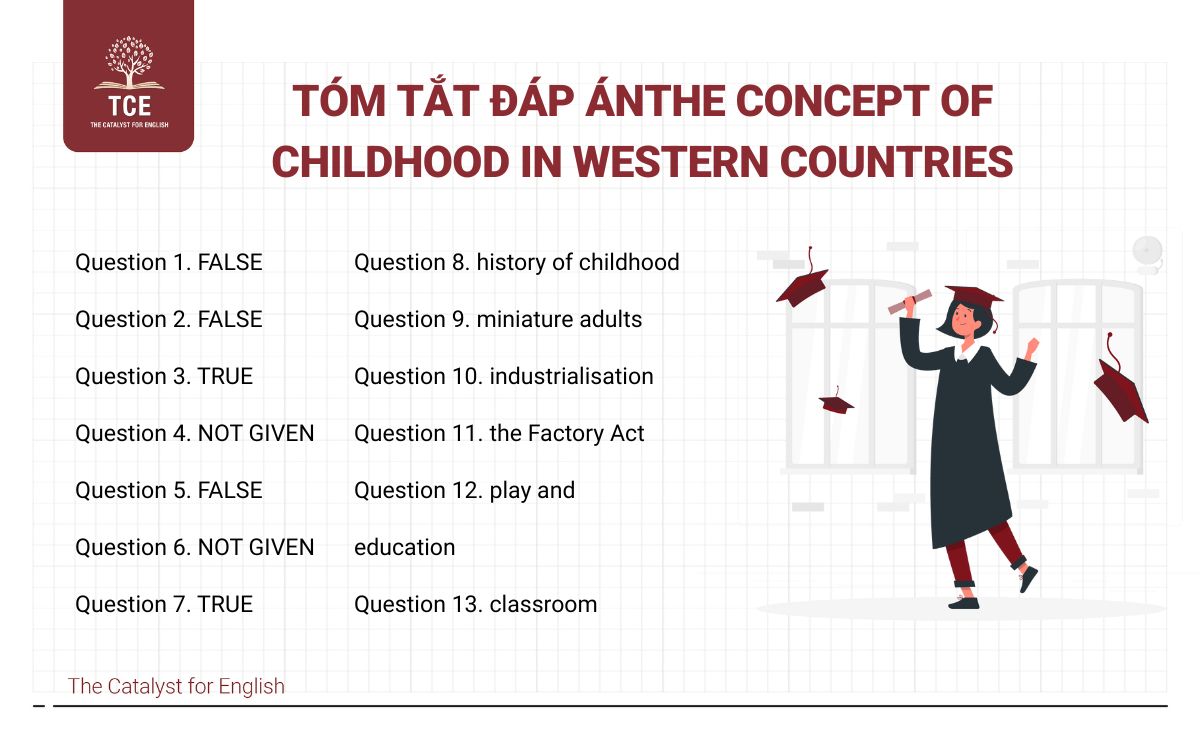
Question 1. FALSE
Vị trí thông tin: “…he concluded that there was no distinction between children and adults for they shared similar leisure activities and work;…”
Kết luận: Thông tin trong bài đọc khẳng định Aries kết luận rằng trẻ em và người lớn chia sẻ công việc tương tự (similar work), điều này trái ngược với khẳng định trong câu hỏi rằng họ làm những loại công việc khác nhau (different types of work).
Question 2. FALSE
Vị trí thông tin: However, this does not mean children were neglected, forsaken or despised, he argued. The idea of childhood corresponds to awareness about the peculiar nature of childhood… Therefore, the concept of childhood is not to be confused with affection for children.
Kết luận: Thông tin trong bài đọc trực tiếp phản bác hoặc làm rõ rằng việc thiếu khái niệm tuổi thơ không đồng nghĩa với việc trẻ em bị đối xử tồi tệ hay không được yêu thương. Do đó, khẳng định chúng “nói chung không được yêu thương” là không đúng (False) theo nội dung của Aries.
Question 3. TRUE
Vị trí thông tin: The issue of whether long hours of labouring would interfere with children’s growing bodies began to perplex social reformers.
Phân tích sự tương đồng (Paraphrasing):
- “Some scientists” (Một số nhà khoa học): Trong bài đọc là “social reformers” (các nhà cải cách xã hội). Mặc dù không hoàn toàn là “nhà khoa học”, nhưng họ là những người có học thức, thực hiện các “systematic studies” (nghiên cứu có hệ thống) và lo lắng về tác động vật lý (growing bodies). Trong ngữ cảnh của bài đọc IELTS, “social reformers” có thể được xem là nhóm người có tư duy hệ thống tương đương với “scientists” trong việc giám sát vấn đề sức khỏe.
- “overwork might damage the health” (làm việc quá sức có thể làm tổn hại sức khỏe): Trong bài đọc là “long hours of labouring would interfere with children’s growing bodies” (giờ lao động kéo dài sẽ cản trở cơ thể đang lớn). “Interfere with” (cản trở/gây ảnh hưởng xấu) và “damage the health” (làm tổn hại sức khỏe) mang ý nghĩa tương đồng trong ngữ cảnh này.
Kết luận: Bài đọc khẳng định các nhà cải cách xã hội đã lo lắng/băn khoăn về tác động tiêu cực của giờ làm việc kéo dài lên cơ thể trẻ em. Do đó, đáp án là TRUE.
Question 4. NOT GIVEN
Vị trí thông tin: The influence of trade unions and economic changes also contributed to the evolution by leaving some forms of child labour redundant during the 19th century.
Phân tích sự khác biệt:
- Bài đọc khẳng định công đoàn “cũng đã đóng góp” (also contributed). Từ “also” (cũng) chỉ ra rằng đây chỉ là một trong nhiều yếu tố (các yếu tố khác bao gồm cải cách nhà máy – factory reform và thay đổi kinh tế – economic changes).
- Bài đọc KHÔNG nói rõ liệu sự đóng góp của công đoàn là “major” (chủ yếu), “chief” (chính), hay là quan trọng nhất so với các yếu tố khác.
- Chúng ta không thể kết luận từ “also contributed” thành “majorly contributed”.
Kết luận: Vì bài đọc chỉ xác nhận công đoàn có đóng góp, nhưng không định lượng mức độ quan trọng của sự đóng góp đó so với các yếu tố khác, nên không có đủ thông tin để khẳng định câu hỏi là Đúng hay Sai. Do đó, đáp án chính xác là NOT GIVEN.
Question 5. FALSE
Vị trí thông tin: The half-time schools established upon the Factory Act of 1833 allowed children to work and attend school. However, a significant proportion of children never attended school in the 1840s, and even if they did, they dropped out by the age of 10 or 11.
Phân tích:
- Câu hỏi khẳng định “most children” (hầu hết/phần lớn trẻ em) đã đến trường.
- Bài đọc khẳng định “a significant proportion… never attended” (một tỷ lệ đáng kể… chưa bao giờ đến trường). Đồng thời, những em đi học cũng bỏ học sớm.
- Việc “một tỷ lệ đáng kể” chưa bao giờ đi học trực tiếp mâu thuẫn với khẳng định “hầu hết trẻ em” đã đi học.
Kết luận: Thông tin trong bài đọc phủ nhận việc hầu hết trẻ em đi học vào giữa thế kỷ 19. Do đó, đáp án chính xác là FALSE.
Question 6. NOT GIVEN
Giải thích: Bài đọc không hề nói rằng trong thế kỷ 20 hầu hết trẻ em phải đi học cả ngày. Do thông tin này không xuất hiện nên đáp án là NOT GIVEN.
Question 7. TRUE
Vị trí thông tin: An increasing number of children are being treated as a group with unique needs, and are organised into groups in the light of their age. For instance, teachers need to know some information about what to expect of children in their classrooms, what kinds of instruction are appropriate for different age groups…
Phân tích sự tương đồng (Paraphrasing):
- “Nowadays”: Bài đọc dùng các cụm từ mô tả hiện tại (“An increasing number of children are being treated…”, nói về giáo viên và hệ thống trường học hiện đại).
- “differentiated and categorised” (phân hóa và phân loại): Trong bài đọc là “treated as a group with unique needs, and are organised into groups” (được đối xử như một nhóm có nhu cầu riêng biệt, và được tổ chức thành các nhóm).
- “based on how old they are” (dựa trên độ tuổi): Trong bài đọc là “in the light of their age” (dựa trên độ tuổi của chúng) và “appropriate for different age groups” (phù hợp cho các nhóm tuổi khác nhau).
Question 8. history of childhood
Keyword Location: The history of childhood has been a heated topic in social history since the highly influential book Centuries of Childhood’, written by French historian Philippe Aries, emerged in 1960.
Giải thích: Bài đọc khẳng định “Lịch sử tuổi thơ” (The history of childhood) trở thành “chủ đề nóng bỏng” (heated topic) kể từ khi cuốn sách của Philippe Aries xuất hiện.
Question 9. miniature adults
Keyword Location: Historian Philippe Aries asserted that children were regarded as miniature adults, with all the intellect and personality that this implies, in Western Europe during the Middle Ages…
Giải thích: Aries khẳng định trẻ em được coi là “miniature adults” (người lớn thu nhỏ) trong thời kỳ Trung Cổ.
Question 10. industrialisation
Keyword Location: In the 18th and 19th centuries, industrialisation created a new demand for child labour; thus many children were forced to work for a long time in mines, workshops and factories.
Giải thích: Bài đọc nêu rõ “industrialisation” (công nghiệp hóa) đã tạo ra “new demand for child labour” (nhu cầu mới về lao động trẻ em) trong khoảng thời gian này.
Question 11. the Factory Act
Keyword Location: For example, in Britain, the Factory Act of 1833 signified the emergence of legal protection of children from exploitation and was also associated with the rise of schools for factory children.
Giải thích: Bài đọc chỉ ra Đạo luật Nhà máy năm 1833 (Factory Act of 1833) là dấu hiệu cho sự ra đời của sự bảo vệ pháp lý dành cho trẻ em khỏi bị bóc lột.
Question 12. play and education
Keyword Location:…and childhood was deemed to be a time for play and education for all children instead of a privileged minority.
Giải thích: Bài đọc nêu rõ “tuổi thơ được coi là thời gian dành cho ‘play and education’ (vui chơi và giáo dục) cho ‘all children’ (tất cả trẻ em) thay vì chỉ dành cho số ít có đặc quyền.
Question 13. classroom
Keyword Location: Once in school, children’s lives could be separated from domestic life and the adult world of work. In this way, school turns into an institution dedicated to shaping the minds, behaviour and morals of the young. Besides, education dominated the management of children’s waking hours through the hours spent in the classroom, homework (the growth of ‘after school’ activities), and the importance attached to parental involvement.
Giải thích: Bài đọc nói rằng việc giáo dục chi phối thời gian thức của trẻ em “through the hours spent in the classroom” (thông qua những giờ dành ra trong lớp học). Điều này ngụ ý lớp học là nơi chính yếu trẻ em ở lại.)
Trên đây là đáp án cùng phần giải thích chi tiết cho IELTS Reading Actual Test Vol 6 Test 1, Passage 1: The Concept of Childhood in Western Countries. Hy vọng nội dung này sẽ hỗ trợ bạn phần nào trong quá trình luyện thi. Nếu bạn còn bất cứ thắc mắc nào liên quan đến bài đọc hoặc các khoá học IELTS tại TCE thì đừng ngần ngại liên hệ với chúng mình để được hỗ trợ chi tiết.
 thecatalyst.edu.vn