Trong kỳ thi IELTS Speaking Part 2, “Describe something you own that you want to replace” là một chủ đề vô cùng phổ biến thuộc nhóm “Describe an object”. Để giúp bạn chinh phục đề bài này, The Catalyst for English xin chia sẻ dàn ý chi tiết, các ý tưởng mở rộng cùng bộ từ vựng đắt giá giúp bài nói của bạn trở nên mạch lạc, tự nhiên và ghi điểm ấn tượng với giám khảo ngay trong bài viết dưới dưới đây.
| Describe something you own that you want to replace
You should say:
- What it is
- When you bought it
- How often you use it
And explain why you want to replace it |
I. Sample answer describe something you own that you want to replace – Speaking Part 2
Today, I’m going to tell you about my current laptop, which is an item I’m planning to replace in the near future. It is an Ultrabook manufactured by Dell – a world-renowned tech giant based in the US.
I’ve had this device for about four years now. I vividly remember getting it right after I moved to Ho Chi Minh City to start my university journey. My parents bought it for me as a gift to support my studies. At the time, it was quite an investment, costing around 18 million VND, which is nearly 700 US dollars. Because of that price point, the build quality was initially excellent. I was particularly fond of its sleek, white design. Being incredibly thin and lightweight with impressive battery longevity, it was the perfect companion to carry between classes.
I use this laptop for almost everything. Primarily, it’s my main tool for completing university assignments and designing PowerPoint presentations. In my downtime, I also opt for it to stream movies or TV series to unwind after a long day of lectures. It has truly been a faithful companion throughout my college years.
However, there are several reasons why I feel it’s time for an upgrade. After four years of heavy daily use, the hardware is starting to show its age. The system has become quite sluggish, and the processing speed isn’t what it used to be. Most frustratingly, the battery has significantly deteriorated, and a few keys on the keyboard have become unresponsive.
Rather than asking my parents for financial help again, I’ve been frugal and saved up my own money over the past year. I’ve spent a lot of time watching tech reviews online and have already set my sights on a specific model. If everything goes according to plan, I hope to treat myself to a brand-new laptop by the end of this year.
Từ vựng ghi điểm:
| Từ |
Phiên âm |
Ý nghĩa |
| World-renowned |
/ˌwɜːrld rɪˈnaʊnd/ |
Nổi tiếng khắp thế giới |
| Tech giant |
/tek ˈdʒaɪənt/ |
“Gã khổng lồ” công nghệ (tập đoàn lớn) |
| An investment |
/ən ɪnˈvestmənt/ |
Một khoản đầu tư |
| Build quality |
/bɪld ˈkwɑːləti/ |
Chất lượng gia công, độ hoàn thiện của sản phẩm |
| Sleek |
/sliːk/ |
Kiểu dáng bóng bẩy, thời thượng, tinh tế |
| Longevity |
/lɔːnˈdʒevəti/ |
Tuổi thọ, độ bền |
| Faithful companion |
/ˈfeɪθfl kəmˈpænjən/ |
Người bạn đồng hành trung thành |
| Unwind |
/ˌʌnˈwaɪnd/ |
Nghỉ ngơi, thư giãn |
| Show its age |
/ʃoʊ ɪts eɪdʒ/ |
Lộ dấu hiệu tuổi tác (cũ kỹ, chậm chạp) |
| Sluggish |
/ˈslʌɡɪʃ/ |
Chậm chạp, trì trệ (máy chạy lag) |
| Deteriorate |
/dɪˈtɪriəreɪt/ |
Xuống cấp, tệ đi |
| Unresponsive |
/ˌʌnrɪˈspɑːnsɪv/ |
Không phản hồi |
| Frugal |
/ˈfruːɡl/ |
Chi tiêu tiết kiệm, chắt bóp |
| Set my sights on |
/set maɪ saɪts ɑːn/ |
Nhắm tới/quyết tâm có được thứ gì đó |
| Treat myself to |
/triːt maɪˈself tuː/ |
Tự thưởng cho bản thân cái gì |
II. Sample answer describe something you own that you want to replace – Speaking Part 3
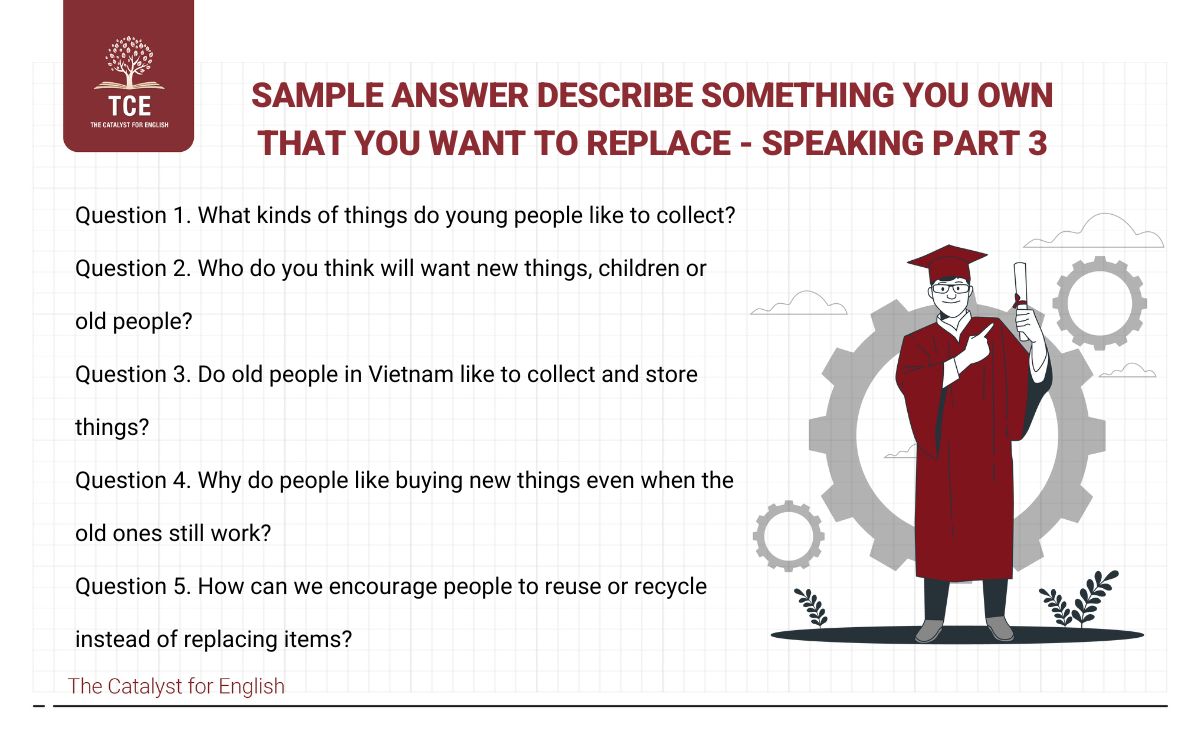
Question 1. What kinds of things do young people like to collect?
In my opinion, the hobbies of young people when it comes to collecting have evolved significantly over the years. Generally, I’d categorize them into two main types.
First, many are drawn to pop culture memorabilia. For instance, it’s incredibly common to see Gen Z collecting limited-edition sneakers, such as Jordans, or K-pop merchandise like photo cards and albums. For them, these items are not just possessions but a way to express their identity and passion for a particular subculture.
Second, there is a growing trend of collecting digital assets. With the rise of technology, many youngsters are now investing in virtual items like skins in video games or even NFTs. This is quite a departure from the traditional stamp or coin collections of previous generations. I think this shift is mainly because young people today value exclusivity and things that hold potential resale value in the digital marketplace.
Từ vựng ghi điểm:
- Memorabilia: Những món đồ kỷ niệm
- Subculture: Tiểu văn hóa
- Exclusivity: Sự độc quyền, duy nhất
- Resale value: Giá trị bán lại
Question 2. Who do you think will want new things, children or old people?
In my opinion, children are far more likely to crave new things, as they are naturally driven by a sense of insatiable curiosity and a desire for instant gratification. They are frequently exposed to enticing advertisements for the latest toys or gadgets, making them more susceptible to trends. In contrast, older people tend to be more frugal and emotionally attached to their current possessions, prioritizing functionality and sentimental value over the novelty of owning something brand-new.
Từ vựng ghi điểm:
- Crave: Khao khát, thèm muốn thứ gì đó
- Insatiable curiosity: Sự tò mò không bao giờ thỏa mãn được
- Instant gratification: Sự thỏa mãn tức thì
- Enticing: Hấp dẫn, lôi cuốn, đầy cám dỗ
- Susceptible to: Dễ bị ảnh hưởng, dễ bị tác động bởi
- Novelty: Sự mới lạ, tính mới mẻ của sự vật
Question 3. Do old people in Vietnam like to collect and store things?
I believe that older people in Vietnam have a very strong tendency to collect and store things, a habit deeply rooted in their historical experiences. Having lived through periods of economic hardship and subsidy years, many seniors developed a mindset of frugality and “saving for a rainy day,” leading them to hoard items like old newspapers, glass jars, or even broken electronics just in case they might be useful later. Furthermore, they are often very sentimental, viewing household objects as mementos of the past, so they find it difficult to discard anything that carries family memories.
Từ vựng ghi điểm:
- Economic hardship: Những khó khăn về kinh tế
- Saving for a rainy day: Tiết kiệm cho những lúc khó khăn/túng thiếu
- Hoard: Tích trữ, thu gom
- Sentimental: Đa cảm, thiên về tình cảm
Question 4. Why do people like buying new things even when the old ones still work?
I believe this behavior stems from a combination of psychological factors and modern marketing. Firstly, there is the novelty effect, where the excitement of owning something brand-new triggers a sense of instant gratification that old items can no longer provide. Secondly, many people are influenced by consumerism and the pressure to keep up with the latest trends to maintain their social status, a phenomenon often called “conspicuous consumption.” Finally, we have to consider planned obsolescence, where manufacturers design products to feel outdated through software or style changes, making consumers feel that their perfectly functional belongings are suddenly obsolete or inadequate.
Từ vựng ghi điểm:
- Stems from: Bắt nguồn từ
- Conspicuous consumption: Tiêu dùng phô trương
- Obsolete: Lạc hậu/Lỗi thời
Question 5. How can we encourage people to reuse or recycle instead of replacing items?
To encourage people to recycle and reuse, I think we need to tackle the problem from three sides. First, governments should offer rewards, like lower taxes for green companies, to make sustainable products cheaper. Second, we need to change people’s mindsets through school and media, showing them that our ‘throwaway culture’ is harming the planet. Finally, it has to be easy. If recycling bins and repair shops are available on every street corner, people will naturally choose to reuse instead of just buying something new.
Từ vựng ghi điểm:
- Throwaway culture: Văn hóa dùng một lần rồi vứt
- Circular economy: Kinh tế tuần hoàn
Question 6. What kinds of products do people tend to replace most frequently?
In my view, people tend to replace high-tech gadgets and fast fashion items more than anything else.
Specifically, smartphones are probably at the top of the list. Due to rapid technological advancements and the “planned obsolescence” we discussed earlier, many consumers upgrade their phones every one or two years to access better cameras or faster processors. Similarly, clothing items are frequently discarded because the fast fashion industry produces cheap, trendy garments that aren’t built to last, leading people to buy new outfits for every season. Additionally, personal care electronics like electric toothbrushes or shavers are often replaced rather than repaired because it’s usually cheaper and more convenient to buy a new model.
Question 7. Do you think people are becoming more wasteful nowadays?
Nowadays, we live in a “throwaway culture” where people prefer the convenience of buying new things over the effort of repairing them. Driven by consumerism and the constant cycle of fast fashion, many of us discard perfectly functional items just to stay on-trend. This behavior is a huge contrast to the frugality of previous generations, leading to a massive increase in global waste.
Từ vựng ghi điểm:
- Consumerism: Chủ nghĩa tiêu dùng
- On-trend: Hợp mốt, đúng xu hướng
- Frugality: Sự tiết kiệm, chắt bóp
Trên đây là những luận điểm, bài mẫu và bộ từ vựng hữu ích xoay quanh chủ đề Describe something you own that you want to replace. Hy vọng những gợi ý này sẽ giúp bạn triển khai ý tưởng dễ dàng hơn và tự tin ghi điểm trong phần thi IELTS Speaking. Đừng quên tham khảo thêm các bài mẫu chất lượng khác từ TCE để từng bước nâng cao band Speaking của mình nhé.
 thecatalyst.edu.vn