Describe a person who helps to protect the environment là một trong những chủ đề thường xuyên xuất hiện trong phần thi IELTS Speaking nhờ tính thực tế và giàu ý nghĩa xã hội. Trong bài viết dưới đây, đội ngũ giáo viên của The Catalyst for English sẽ hướng dẫn bạn cách triển khai bài nói sao cho hiệu quả và tự nhiên cho đề bài này nhé.
I. Tổng quan về chủ đề Describe a person who helps to protect the environment
Chủ đề bảo vệ môi trường là một nhánh nội dung quan trọng trong bộ đề IELTS Speaking. Để xử lý tốt từ khóa này, thí sinh không chỉ cần khả năng mô tả người mà còn phải lồng ghép khéo léo các hành động cụ thể mang tính bền vững.
Khi gặp đề bài Describe a person who helps to protect the environment, bạn cần bám sát cấu trúc 4 câu hỏi gợi ý thường gặp trong Cue card để đảm bảo bài nói kéo dài đủ 2 phút và có tính liên kết:
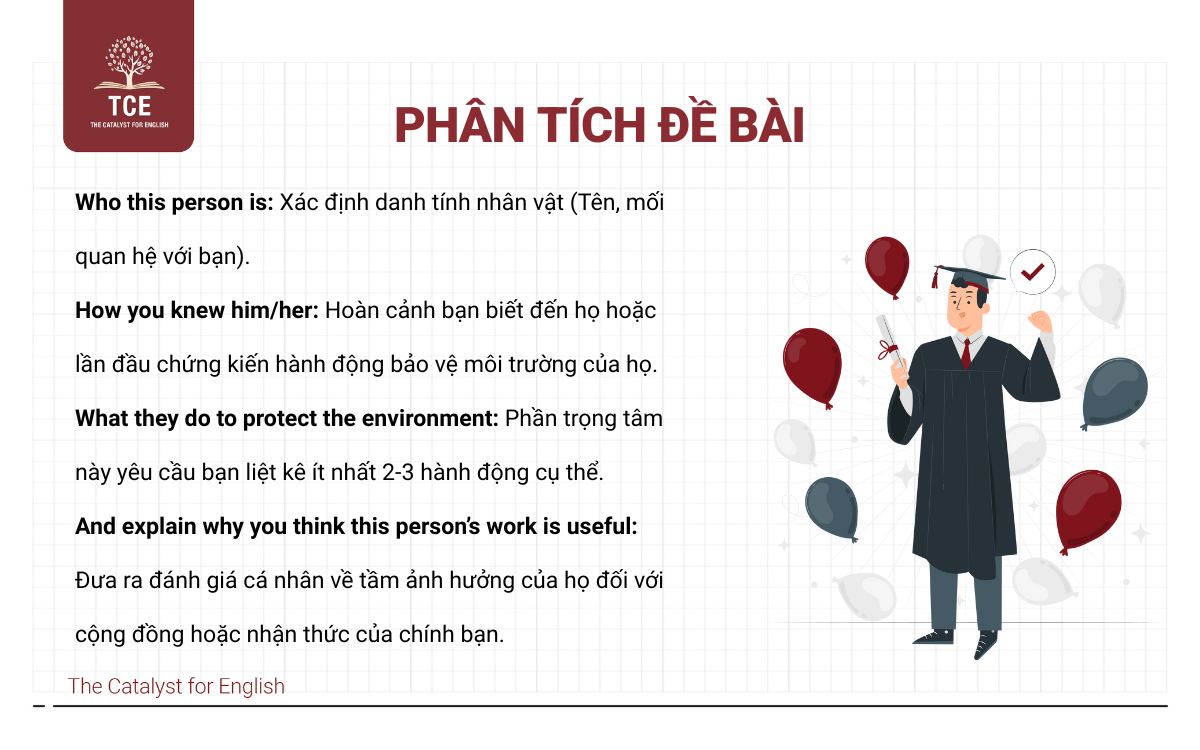
Who this person is: Xác định danh tính nhân vật (Tên, mối quan hệ với bạn).
How you knew him/her: Hoàn cảnh bạn biết đến họ hoặc lần đầu chứng kiến hành động bảo vệ môi trường của họ.
What they do to protect the environment: Phần trọng tâm này yêu cầu bạn liệt kê ít nhất 2-3 hành động cụ thể (ví dụ: phân loại rác, hạn chế nhựa dùng một lần, tham gia chiến dịch trồng cây).
And explain why you think this person’s work is useful: Đưa ra đánh giá cá nhân về tầm ảnh hưởng của họ đối với cộng đồng hoặc nhận thức của chính bạn.
II. Từ vựng ăn điểm chủ đề Environment
Một yếu tố nữa để giúp bài nói về bữa tiệc ghi điểm đó là các từ vựng phong phú và giàu sức biểu cảm. Hãy lấy giấy bút ra và ghi lại các từ vựng hay cho đề describe a person who helps to protect the environment mà TCE gợi ý cho bạn nhé!
Từ
Ý nghĩa
Environmental degradation
Sự suy thoái môi trường
Carbon footprint
Lượng khí thải carbon cá nhân
To be teetering on the brink of destruction
Đang trên bờ vực của sự hủy diệt
Irreparable damage
Những tổn hại không thể cứu vãn
The proliferation of single-use plastics
Sự gia tăng nhanh chóng của nhựa dùng một lần
Global warming & Greenhouse gas emissions
Sự nóng lên toàn cầu và khí thải nhà kính
To adopt a zero-waste lifestyle
Áp dụng lối sống không rác thải
To opt for sustainable alternatives
Lựa chọn các phương án thay thế bền vững (ví dụ: dùng túi vải thay túi nilon)
To sort waste into categories
Phân loại rác thải
Energy-efficient appliances
Các thiết bị tiết kiệm năng lượng
To promote biodiversity
Thúc đẩy đa dạng sinh học
Environmentally-conscious/Eco-conscious
Có ý thức về môi trường
To mitigate the impact of climate change
Giảm nhẹ tác động của biến đổi khí hậu
A source of inspiration
Một nguồn cảm hứng
To lead by example
Làm gương để người khác noi theo
To set a good example for the younger generation
Nêu gương tốt cho thế hệ trẻ
To raise public awareness of…
Nâng cao nhận thức cộng đồng về vấn đề…
To instill a sense of environmental responsibility in somebody
Làm thấm nhuần ý thức trách nhiệm về môi trường vào ai đó
To play a pivotal role in…
Đóng một vai trò nòng cốt trong việc…
III. Bài mẫu describe a person who helps to protect the environment part 2
Today, I’m going to talk about my cousin, Linh, a person whom I truly admire for her tireless efforts to protect the environment. Currently a 21-year-old Marketing student, Linh has been my close companion since our childhood, as our families live in the same neighborhood.
In terms of appearance, she is a petite girl with a sweet smile and a very approachable vibe. However, don’t let her simple style fool you; she is a dedicated eco-warrior in her own right. What initially strikes me about Linh is that she is never seen without her reusable water bottle, which speaks volumes about her commitment to a sustainable lifestyle.
If my memory serves me right, her passion for environmental issues was ignited about three years ago after she watched a compelling documentary about the devastating effects of climate change. Since that turning point, she has made significant adjustments to her daily routines. For instance, she has completely phased out single-use plastics and always carries her own biodegradable shopping bags to the local market.
What I find most commendable is that Linh doesn’t just keep these habits to herself; she actively strives to raise public awareness. She frequently shares practical tips on social media regarding waste reduction and energy conservation. Whenever we hang out, she talks passionately about how individual small actions can collectively mitigate environmental degradation.
Honestly, her influence has been transformative for me. Thanks to her, I’ve become far more environmentally conscious, adopting habits like avoiding food waste and reducing my own carbon footprint. I feel immensely proud to have such a positive role model in my life, and I truly believe that the world would be a much better place if there were more people like her spreading these eco-friendly messages.
Từ vựng ghi điểm:
Từ
Phiên âm
Ý nghĩa
Tireless efforts
/ˈtaɪələs ˈefəts/
Những nỗ lực không ngừng nghỉ
Close companion
/kləʊs kəmˈpænjən/
Người bạn đồng hành thân thiết
Petite
/pəˈtiːt/
Nhỏ nhắn, mảnh mai
Approachable vibe
/əˈprəʊtʃəbl vaɪb/
Cảm giác gần gũi, dễ gần
Eco-warrior
/ˈiːkəʊ ˈwɒriə(r)/
Chiến binh môi trường (người nhiệt huyết bảo vệ môi trường)
IV. Bài mẫu describe a person who helps to protect the environment part 3
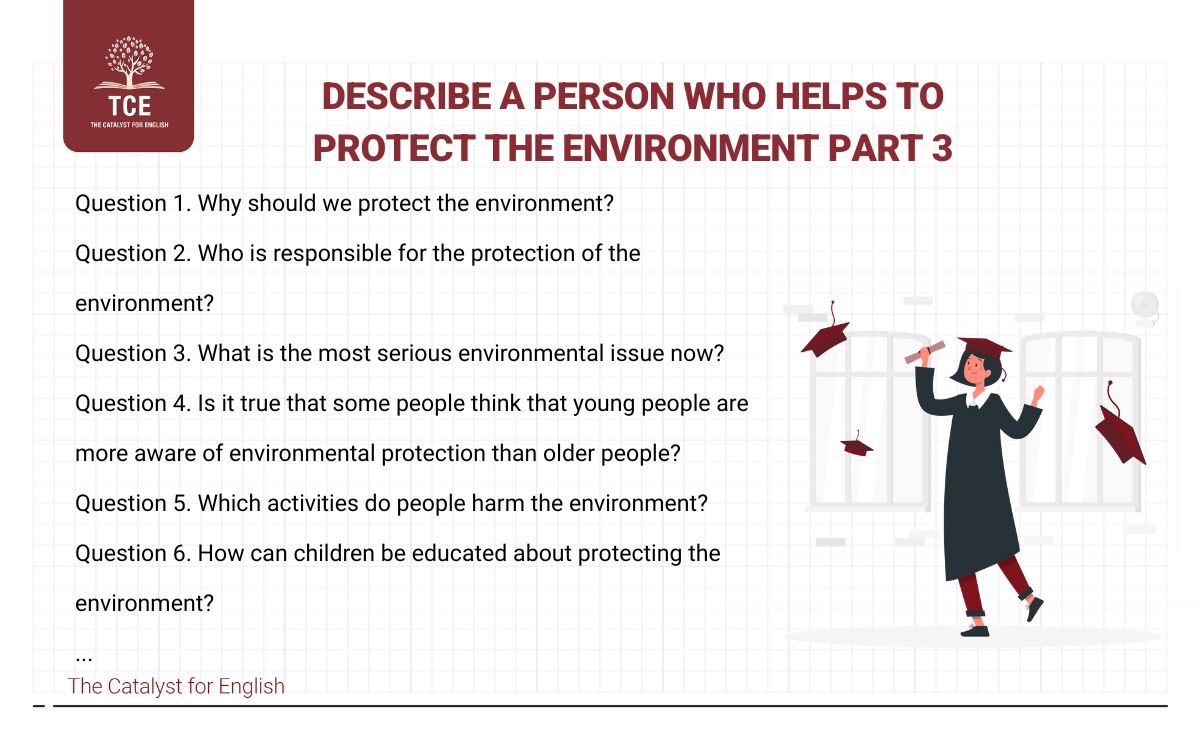
Question 1. Why should we protect the environment?
Protecting the environment is absolutely vital because it directly impacts our well-being and survival. Firstly, a healthy ecosystem provides us with essential resources like clean air, fresh water, and fertile soil for food production, which are the building blocks of life. Furthermore, taking action to mitigate climate change is a responsibility we owe to future generations to ensure they inherit a habitable planet. Ultimately, by preserving nature, we are not just saving wildlife but effectively safeguarding our own health and the global economy from natural disasters.
Question 2. Who is responsible for the protection of the environment?
In my perspective, environmental protection is a shared responsibility that requires a multi-layered approach. While individuals can contribute by adopting eco-friendly habits like recycling or reducing waste, I believe the primary responsibility lies with governments and large corporations. Authorities have the power to enforce stringent regulations on industrial emissions, while businesses must shift towards sustainable production to minimize their ecological footprint. Ultimately, it is only through the collaborative efforts of both policymakers and citizens that we can achieve long-term environmental stability.
Question 3. What is the most serious environmental issue now?
From my perspective, climate change is the most pressing environmental issue we face today due to its catastrophic and far-reaching impacts. This global phenomenon has led to unpredictable weather patterns, such as prolonged droughts and severe floods, which directly threaten food security and human habitats. In a developing country like Vietnam, the rising sea levels are particularly alarming as they endanger our coastal regions and agriculture. Ultimately, if we do not take immediate action to reduce greenhouse gas emissions, the damage to our planet’s ecosystem may soon become irreversible.
Question 4. Is it true that some people think that young people are more aware of environmental protection than older people?
It is often argued that the younger generation is more environmentally conscious than their predecessors, and I believe there is some truth to this. Nowadays, youth are exposed to environmental education from an early age and have constant access to information through social media platforms. For instance, many teenagers are leading zero-waste movements or actively participating in climate strikes, which were less common in the past. However, we shouldn’t overlook many older people who practice sustainability through traditional habits like frugality and repairing items instead of discarding them. Ultimately, while young people might be more vocal and tech-savvy in their activism, both generations contribute to environmental conservation in their own unique ways.
Question 5. Which activities do people harm the environment?
There is a wide range of human activities that contribute to environmental degradation, but the most prominent one is the over-reliance on fossil fuels for transportation and energy production. This release of carbon emissions is a primary driver of global warming. Furthermore, the modern culture of convenience has led to the excessive use of single-use plastics, which results in massive amounts of non-biodegradable waste ending up in our oceans. Additionally, large-scale industrial activities and deforestation for agriculture are destroying natural habitats, causing a significant loss of biodiversity. Ultimately, both our daily consumption habits and global industrial practices are putting immense pressure on the planet’s ecosystem.
Question 6. How can children be educated about protecting the environment?
I believe that the most effective way to educate children is through hands-on experience rather than just theoretical lessons in textbooks. Schools can integrate environmental stewardship into their curriculum by organizing outdoor activities like tree planting or local clean-up campaigns. Furthermore, parents play a pivotal role by setting a good example at home, such as teaching kids how to sort waste or save electricity. By involving them in these small but meaningful actions, we can instill a sense of responsibility in the younger generation from an early age. Ultimately, when children witness the direct impact of their efforts, they are more likely to adopt a sustainable lifestyle as they grow up.
Question 7. Is volunteering common among young people?
In my experience, volunteering has become increasingly popular among the younger generation, particularly as they become more socially and environmentally conscious. Many students and young professionals now actively participate in community projects or non-profit organizations to gain practical experience and expand their social circles. Moreover, the rise of social media has made it much easier for youth to discover and join charitable movements that align with their personal values. This trend not only benefits society but also helps youngsters develop essential life skills such as leadership and empathy.
Question 8. Is it important to teach students environmental protection at school?
I absolutely believe that integrating environmental education into the school curriculum is essential for fostering a sustainable future. By learning about ecological issues early on, students can develop a strong sense of responsibility and adopt eco-friendly habits that last a lifetime. Furthermore, schools provide a structured environment where young people can engage in hands-on activities, such as recycling programs or tree planting, to understand their impact on the planet. Ultimately, educating the younger generation is the most effective way to mitigate environmental degradation on a global scale.
Question 9. Do you think technology can improve environment-related problems?
I definitely agree that technology plays a pivotal role in tackling environmental challenges and promoting sustainability. Advanced innovations, such as renewable energy systems and carbon capture techniques, are already significantly reducing our reliance on fossil fuels. Furthermore, smart waste management and AI-driven monitoring help us track pollution levels more accurately, allowing for more timely and effective interventions. Ultimately, while technology is not a silver bullet, it provides the cutting-edge tools necessary to mitigate human impact on the ecosystem.
Question 10. What have people done to damage the environment?
In my view, human activities have caused significant environmental degradation through the over-exploitation of natural resources and industrial expansion. The primary culprit is the massive emission of greenhouse gases from factories and vehicles, which has intensified global warming. Additionally, the widespread disposal of non-biodegradable plastics and large-scale deforestation for agriculture have led to severe habitat loss and water pollution. Ultimately, our modern culture of convenience and pursuit of economic growth have placed an immense strain on the planet’s delicate ecosystems.
Question 11. Why can recycling help the environment?
Recycling plays a crucial role in protecting the planet by significantly reducing the need for raw material extraction, which preserves our limited natural resources. By re-processing used materials, we can save a vast amount of energy and lower greenhouse gas emissions compared to producing goods from scratch. Furthermore, it effectively diverts waste from already overflowing landfills, thereby minimizing soil and water contamination. Ultimately, widespread recycling is a key component of a circular economy, helping to mitigate the overall human impact on our fragile ecosystems.
Question 12. What do you think are the greatest environmental problems facing your country at present?
In my view, Vietnam is currently grappling with severe air and water pollution, especially in major metropolitan areas due to rapid industrialization. The excessive emissions from millions of motorbikes and factories have led to deteriorating air quality, which poses significant health risks to urban residents. Additionally, the massive discharge of untreated waste into river systems is a pressing concern that threatens our agriculture and aquatic ecosystems. Ultimately, these issues require urgent governmental intervention and a collective shift toward sustainable development to ensure a cleaner living environment.
Question 13. Should countries try to solve climate change problems together or individually? Why?
I firmly believe that addressing climate change requires a collaborative global effort rather than individual actions because environmental issues know no borders. Since greenhouse gas emissions produced in one nation affect the entire planet’s atmosphere, a unified strategy is essential to achieve significant results. Furthermore, international cooperation allows developed countries to share green-energy technology and financial resources with developing nations to ensure global sustainability. Ultimately, only through collective commitment and shared responsibility can we effectively mitigate the catastrophic impacts of global warming on a worldwide scale.
V. Tham gia thi thử IELTS Online tại The Catalyst for English
Bài mẫu và bộ từ vựng band 7.5+ trên mang đến cho bạn nguồn tham khảo hữu ích. Tuy nhiên, hiểu kiến thức là một chuyện, còn vận dụng linh hoạt trong điều kiện phòng thi lại là thử thách không hề đơn giản.
Vậy làm thế nào để biết trình độ hiện tại của bạn và đâu là bước đi phù hợp tiếp theo?
Điều quan trọng đầu tiên là đánh giá đúng năng lực. Bạn có thể tham gia bài thi thử IELTS 4 kỹ năng tại The Catalyst để nhận được kết quả chi tiết, sát với kỳ thi thật. Dựa trên điểm số và lỗi sai cụ thể, đội ngũ giảng viên sẽ tư vấn lộ trình luyện thi IELTS cá nhân hóa, tập trung cải thiện điểm yếu và giúp bạn nâng band hiệu quả.
Trên đây đội ngũ TCE đã giới thiệu đến bạn hệ thống dàn ý chi tiết, từ vựng học thuật và các mẫu câu trả lời cho topic “Describe a person who helps to protect the environment” trong IELTS Speaking Part 2 và 3. Hy vọng rằng những kiến thức chuyên sâu này sẽ giúp bạn làm chủ các tình huống giao tiếp về chủ đề môi trường và tự tin áp dụng vào trong bài thi IELTS Speaking của mình. Chúc bạn học tập hiệu quả và chinh phục band điểm cao trong bài thi thực tế.
Xin chào, mình là Phương ThảoCo-founder tại The Catalyst for English. Với hơn 7 năm kinh nghiệm đồng hành cùng các bạn học viên trên con đường chinh phục tiếng Anh, IELTS và sở hữu điểm Overall 8.5, mình luôn mong muốn chia sẻ những phương pháp học tập hiệu quả nhất để giúp bạn tiết kiệm thời gian và đạt được kết quả cao.
Tại The Catalyst for English, mình cùng đội ngũ giáo viên luôn đặt 3 giá trị cốt lõi: Connected – Disciplined – Goal-oriented (Kết nối – Kỉ luật – Hướng về kết quả) lên hàng đầu. Bởi chúng mình hiểu rằng, mỗi học viên đều có những điểm mạnh và khó khăn riêng, và vai trò của "người thầy" là tạo ra một môi trường học tập thân thiện, luôn luôn thấu hiểu và đồng hành từng học viên, giúp các bạn không cảm thấy "đơn độc" trong một tập thể.
Những bài viết này được chắt lọc từ kinh nghiệm giảng dạy thực tế và quá trình tự học IELTS của mình, hy vọng đây sẽ là nguồn cảm hứng và hành trang hữu ích cho các bạn trên con đường chinh phục tiếng Anh.
 thecatalyst.edu.vn