“Describe a famous person that you are interested in” là chủ đề quen thuộc trong IELTS Speaking Part 2 và cả các bài viết tiếng Anh. Tuy nhiên, làm sao để không chỉ kể thông tin mà còn xây dựng được một câu chuyện cuốn hút lại là thử thách với nhiều bạn. Trong bài viết dưới đây, TCE sẽ cung cấp những từ vựng đắt giá cùng bài mẫu tham khảo, giúp bạn tự tin ghi điểm với giám khảo.
I. Tổng quan về chủ đề Describe a famous person that you are interested in
Describe a famous person that you are interested in dạng bài thuộc nhóm Describing People, đòi hỏi sự kết hợp nhuần nhuyễn giữa việc cung cấp thông tin thực tế và bộc lộ cảm xúc cá nhân. Để chinh phục hoàn toàn giám khảo, bạn không chỉ cần nói họ là ai, mà phải làm bật lên được lý do tại sao họ lại có sức hút đặc biệt đối với bạn.
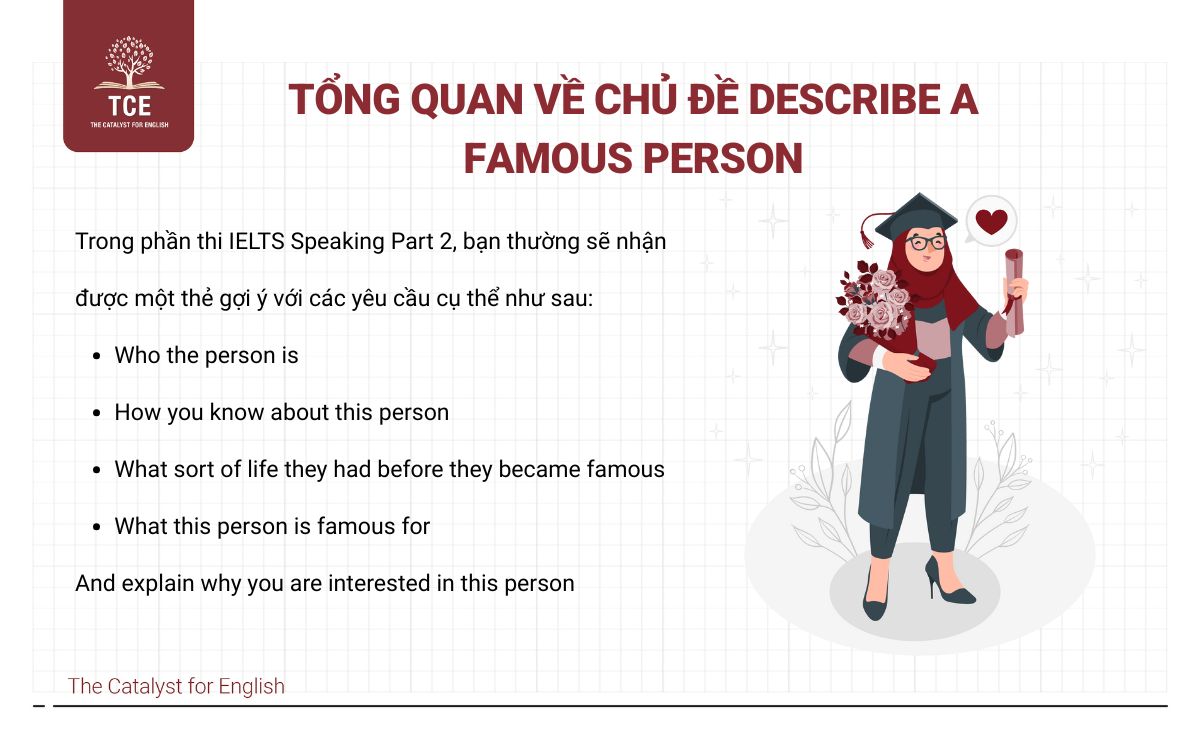
Trong phần thi IELTS Speaking Part 2, bạn thường sẽ nhận được một thẻ gợi ý (Cue Card) với các yêu cầu cụ thể như sau:
- Who the person is: Tên, lĩnh vực hoạt động (nghệ thuật, kinh doanh, thể thao…).
- How you know about this person: Bạn biết đến họ qua phương tiện truyền thông, mạng xã hội hay một sự kiện cụ thể nào?
- What sort of life they had before they became famous: (Tùy chọn) Những nỗ lực hoặc khó khăn họ đã trải qua trước khi thành danh.
- What this person is famous for: Những thành tựu rực rỡ hoặc đóng góp quan trọng của họ cho cộng đồng.
- And explain why you are interested in this person: Đây là phần quan trọng nhất, nơi bạn giải thích sức ảnh hưởng và bài học mà bạn rút ra từ họ.
II. Tổng hợp từ vựng cho chủ đề describe a famous person
Sau đây, cô Thảo (8.5 IELTS), giáo viên tại TCE, đã tổng hợp những từ vựng quan trọng xoay quanh chủ đề describe a famous person, giúp bạn diễn đạt ý tưởng mạch lạc hơn trong bài thi IELTS Speaking:
| Từ |
Ý nghĩa |
| Persistent / Tenacious |
Kiên trì, bền bỉ (Dùng cho những người vượt qua nghịch cảnh). |
| Visionary |
Có tầm nhìn xa trông rộng |
| Down-to-earth |
Khiêm tốn, thực tế |
| Altruistic |
Vị tha, luôn nghĩ cho người khác |
| Indomitable |
Bất khuất, không thể bị khuất phục |
| Rise to stardom/prominence |
Trở nên nổi tiếng, vụt sáng thành sao |
| A household name |
Một cái tên quen thuộc với mọi nhà |
| Trailblazer / Pioneer |
Người tiên phong, người mở đường trong một lĩnh vực |
| Legacy |
Di sản (Những giá trị tinh thần hoặc vật chất họ để lại cho đời) |
| Uphold one’s reputation |
Duy trì danh tiếng (Sống đúng với các chuẩn mực đạo đức). |
| To set a good example for… |
Làm gương tốt cho ai đó |
| To leave a lasting impression on someone |
Để lại ấn tượng sâu đậm trong lòng ai |
| To be in the public eye |
Thường xuyên xuất hiện trước công chúng/bị dư luận soi xét |
| Against all odds |
Vượt qua mọi khó khăn, nghịch cảnh (Dùng khi kể về thành công của họ). |
| To be a source of inspiration to… |
Là nguồn cảm hứng bất tận cho… |
| To think outside the box |
Suy nghĩ đột phá, không theo lối mòn |
III. Bài mẫu describe a famous person that you are interested in part 2
Today, I’m going to talk about a figure whose name has become synonymous with genius: Albert Einstein. He was a world-renowned physicist who fundamentally redefined the laws of nature and reshaped our perception of the physical world.
I first stumbled upon Einstein’s legacy back in my secondary school years. In the classrooms where science was brought to life, his name was virtually everywhere – from the complex diagrams in our textbooks to the inspiring anecdotes shared by my physics teacher. It felt as though his presence was an integral part of our scientific curriculum.
What I find most intriguing is his life before he rose to prominence. Long before he was celebrated worldwide, Einstein worked as a humble patent clerk. In that quiet office, he was often lost in his own world of intricate equations, seemingly disconnected from the mundane routine around him. At that time, he was a genius unrecognized, a trailblazer whose immense talent remained largely untapped by the academic elite.
His most groundbreaking achievement, the Theory of Relativity, eventually became a cornerstone of modern physics. It completely revolutionized our understanding of space, time, and gravity. However, my fascination with him goes beyond his intellectual prowess; it’s his unwavering resilience that truly captivates me. In the early stages, his radical ideas were often ridiculed and his theories flatly rejected by his peers. Yet, he unflinchingly pursued his passion for decoding the universe.
Einstein once famously remarked, “Imagination is more important than knowledge.” He truly lived by these words, constantly challenging the norm and daring to imagine the unimaginable. To me, Einstein is more than just a historical figure to admire; he is a constant source of inspiration that encourages me to question, to explore, and above all, to persevere against all odds. He proved that with enough curiosity, even the universe is not the limit.
Từ vựng ghi điểm:
| Từ |
Ý nghĩa |
| Synonymous with [something] |
Đồng nghĩa với cái gì |
| Rose to prominence |
Trở nên nổi tiếng/vụt sáng |
| Trailblazer |
Người tiên phong/người mở đường |
| Redefine the laws of nature |
Định nghĩa lại các quy luật tự nhiên |
| Groundbreaking achievement |
Thành tựu mang tính đột phá |
| Cornerstone of [something] |
Viên gạch đặt nền móng/nền tảng cho một lĩnh vực nào đó. |
| Revolutionized our understanding |
Cách mạng hóa sự hiểu biết của chúng ta. |
| Intellectual prowess |
Năng lực trí tuệ xuất chúng |
| Unwavering resilience |
Sự kiên cường, bền bỉ không lay chuyển |
| Unflinchingly |
Một cách kiên định, không hề nao núng |
| Untapped talent |
Tài năng chưa được khai phá/khai thác |
| Challenging the norm |
Thách thức những quy chuẩn thông thường |
| Persevere against all odds |
Kiên trì vượt qua mọi nghịch cảnh/khó khăn |
| Lost in one’s own world |
Đắm chìm trong thế giới riêng |
| Brought to life |
Trở nên sống động |
| A source of inspiration |
Một nguồn cảm hứng |
Xem thêm:
IV. Bài mẫu describe a famous person that you are interested in part 3
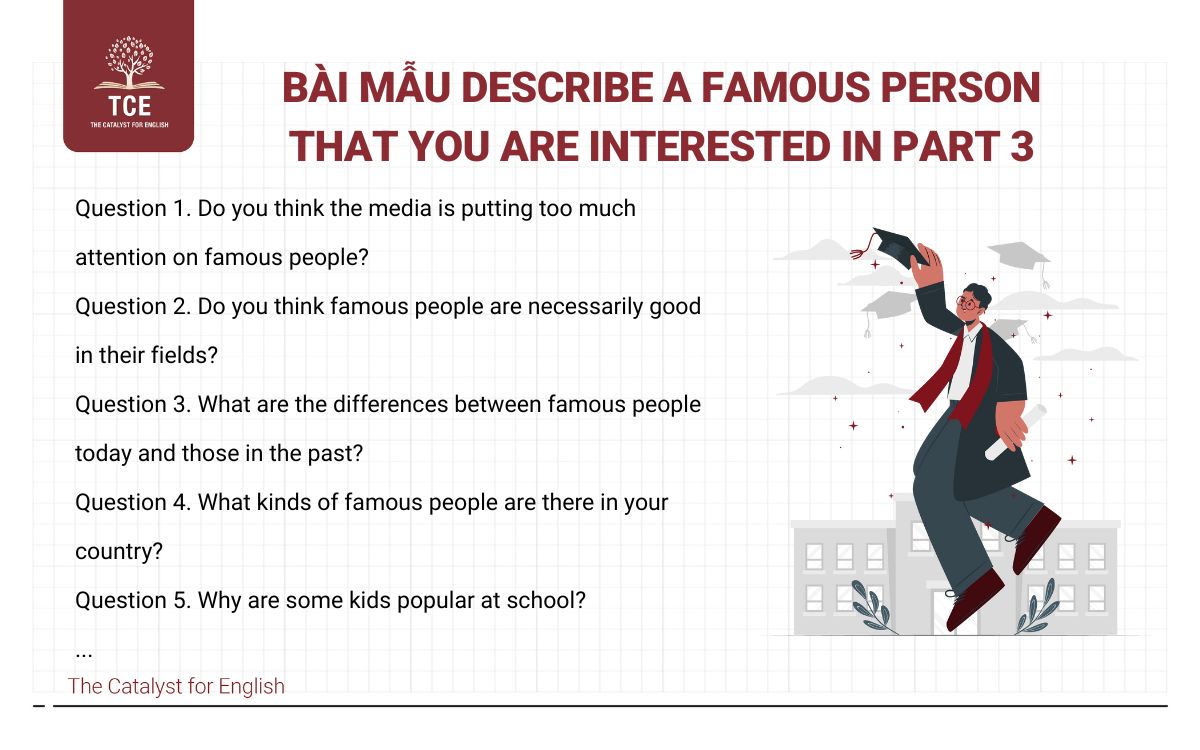
Question 1. Do you think the media is putting too much attention on famous people?
Personally, I believe the media is indeed disproportionately focused on the lives of celebrities, often at the expense of more pressing global issues. This ceaseless obsession stems from the high commercial value of celebrity gossip, which effectively drives engagement and advertising revenue. However, this trend can be quite detrimental as it invades the privacy of public figures and creates unrealistic standards for the younger generation to follow. While some coverage is necessary to keep fans informed, the current level of media scrutiny often crosses ethical boundaries, turning personal struggles into a form of public entertainment.
Question 2. Do you think famous people are necessarily good in their fields?
From my perspective, fame does not always correlate with exceptional competence or talent in a specific field. In the digital age, many individuals rise to prominence through viral trends or strategic self-promotion rather than genuine expertise or hard work. Conversely, there are numerous unsung heroes in science or education who possess profound skills but remain largely unknown to the general public. Therefore, while popularity can sometimes reflect a person’s success, it is by no means a definitive yardstick for measuring their true professional capabilities.
Question 3. What are the differences between famous people today and those in the past?
In my view, the fundamental difference lies in the accessibility and the path to stardom. In the past, fame was often reserved for those with exceptional talent or long-term achievements, and was strictly filtered by traditional media like TV or newspapers. Conversely, in the digital era, the emergence of social media has democratized fame, allowing anyone to become an overnight sensation through viral content. Furthermore, the lives of modern celebrities are much more transparent and exposed to the public eye, whereas historical figures maintained a certain level of mystique and privacy.
Question 4. What kinds of famous people are there in your country?
In Vietnam, the landscape of celebrity is quite diverse, but it can be broadly categorized into three main groups. Firstly, there are traditional icons such as A-list singers and actors who have built their reputation through years of artistic contribution. Secondly, the meteoric rise of social media has given birth to a new generation of content creators and influencers who command massive followings on platforms like TikTok or Facebook. Lastly, there is a profound respect for intellectual figures and elite athletes who bring national pride to the country through their academic achievements or international sports titles.
Question 5. Why are some kids popular at school?
In my opinion, popularity among children often stems from a combination of interpersonal skills and exceptional talents. Children who are extroverted and possess a high level of emotional intelligence tend to be more well-liked as they can easily navigate social circles and build rapport with their peers. Additionally, those who excel in highly visible areas such as sports or performing arts often command admiration, as these achievements are easily recognized in a school environment. Ultimately, being a charismatic leader or simply showing kindness can also make a child a prominent figure in their social group.
Question 6. Why do some people become famous but not successful?
From my perspective, this phenomenon often occurs because fame and success are measured by entirely different metrics. Many individuals become notorious or gain fleeting fame through scandals or viral social media stunts, which lack a foundation of genuine achievement or financial stability. Conversely, true success typically implies long-term sustainability, professional recognition, and personal fulfillment. Therefore, someone might be in the public eye and widely recognized, yet they may lack the substantial legacy or the sense of accomplishment that defines a truly successful life.
Question 7. Do you think that famous people are generally happier than ordinary people?
In my opinion, fame is a double-edged sword that doesn’t necessarily guarantee a higher level of happiness. While celebrities enjoy material wealth and public adoration, they often suffer from a total lack of privacy and constant media scrutiny, which can lead to immense psychological pressure. In contrast, ordinary people may lack the glamour, but they have the freedom to lead a low-profile life and foster genuine relationships without the fear of judgment. Ultimately, true contentment stems from inner peace rather than the external validation that comes with being a public figure.
Question 8. What qualities does a person need to have in order to be famous?
To my mind, attaining fame requires a blend of exceptional talent and unwavering perseverance. Beyond having a unique skill, a person must possess a resilient mindset to endure the intense pressure and public criticism that often accompany life in the spotlight. Furthermore, in the digital age, being charismatic and having the ability to self-promote are crucial, as individuals need to build a strong personal brand to stand out from the crowd. Ultimately, it is the combination of authenticity and a bit of luck that often transforms an ordinary person into a household name.
Question 9. Is it easier or more difficult to achieve fame today than in your grandparents’ time?
Becoming famous today is a paradox: it is easier to gain attention but more difficult to maintain it. In my grandparents’ time, the path to fame was stringent and controlled by a few traditional media gatekeepers, meaning once you were famous, your position was relatively secure. Conversely, the digital era has lowered the barrier to entry, allowing anyone to become an overnight sensation via social media. However, this has led to a saturated market where fame is often transient, making it far more challenging to sustain long-term public interest compared to the past.
Question 10. Do you think more is expected from famous people than ordinary citizens?
I strongly believe that the public holds celebrities to a much higher moral standard than ordinary citizens. Since famous people possess a significant platform and influence millions, their actions and words can shape societal values, especially among the impressionable youth. Consequently, they are often expected to be role models and are subject to intense criticism for even minor lapses in judgment. While ordinary individuals have the luxury of making mistakes in private, public figures must navigate their lives under a microscope, where every move is scrutinized for its social and ethical impact.
Nếu bạn đang hướng tới mục tiêu cải thiện IELTS, đặc biệt là kỹ năng Speaking, khóa học IELTS tại The Catalyst for English là lựa chọn đáng cân nhắc. Với đội ngũ giảng viên giàu kinh nghiệm, giáo trình độc quyền, lớp học sĩ số nhỏ cùng các buổi hỗ trợ 1 1 hằng tuần, TCE giúp bạn học tập hiệu quả và đúng trọng tâm. Ngoài ra, học viên còn được tham gia thi thử IELTS sát đề thật và nhận đánh giá chi tiết Speaking, Writing từ giám khảo chuyên môn, hỗ trợ bạn tự tin hơn trước kỳ thi chính thức.
Như vậy, TCE đã chia sẻ đến bạn những từ vựng, cấu trúc cùng bài mẫu tiêu biểu cho chủ đề describe a famous person that you are interested in trong IELTS Speaking Part 2. Hi vọng rằng các kiến thức trên sẽ giúp bạn tự tin hơn khi xây dựng câu trả lời mạch lạc, giàu cảm xúc và xử lý tốt những đề bài tương tự trong kỳ thi IELTS. Chúc bạn ôn luyện hiệu quả và sớm đạt band điểm mong muốn.
 thecatalyst.edu.vn